Wind Power Generation Equipment Main Shaft Oil Seal
風力発電主軸用シール / JTEKT Corporation (Official website) / Listed on page 7 of the document
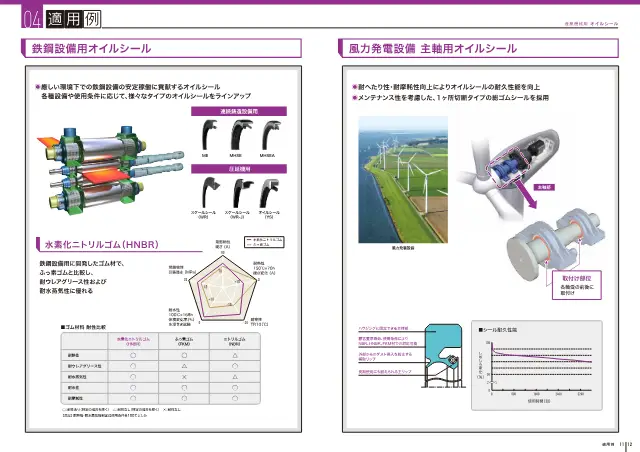
All-rubber seal with one-piece split design, featuring improved set resistance and abrasion resistance for ease of maintenance.
Last verified: (date the content was verified against the source document)
A reduced image of the relevant page is quoted from the document. Copyright belongs to JTEKT Corporation.Request removal
Specifications
| Interference Change Over Service Time | Maintains a constant retention rate even with long-term use |
|---|
How to choose Oil Seals
Points to check when selecting, with the values for this product (Wind Power Generation Equipment Main Shaft Oil Seal).
-
1. Match shaft diameter and housing bore
Select shaft diameter d and outer diameter D by nominal dimensions to suit the mating shaft and housing bore. Listed shaft diameters range widely from 6 to 3530 mm. Some standard types are designed assuming shaft tolerance h8 and housing bore tolerance H7/H8. Deviation from fit tolerances can cause leakage or seal dislodgement.
-
2. Check width fits the installation space
Confirm that width b fits within the axial installation space. Listed products are 5 to 30 mm. For large types, cross-section width, groove width, and presence of spacers are also part of the dimensional requirements, so verify against the housing groove dimensions.
-
3. Select lip material suited to fluid and temperature
Lip material governs oil resistance and heat resistance. Nitrile rubber is a general-purpose material for mineral oils, acrylic and fluororubber suit the high-temperature range, and silicone readily covers low to high temperatures. PTFE lips are suitable for chemicals and high temperatures, and food-hygiene-compliant materials are available for food machinery.
-
4. Allow margin in operating temperature range
Confirm that the continuous operating temperature range includes the running oil temperature. Temporary temperature rises, such as at startup, are judged by the short-term maximum temperature (120 °C in one listed example). However, if the normal operating temperature is close to the upper limit, rubber hardening and lip wear will accelerate.
-
5. Verify shaft surface speed is within limit
Surface speed is the lip sliding speed calculated from shaft diameter and rotational speed. The listed maximum surface speeds are 5 to 20 m/s, and exceeding them causes lip deterioration from frictional heat. Even at the same rotational speed, surface speed increases with larger shaft diameter, so check this particularly for large-diameter shafts.
-
6. Confirm maximum sealing pressure limit
Standard oil seals are intended for low-pressure use. Listed maximum operating pressures vary greatly by type, from 0.03 to 15 MPa, so select a pressure-resistant type for applications with internal pressure. Under pressure the lip is pressed strongly against the shaft, making heat generation more likely.
This guide was written by AI based on the listed products' documents and specification items.
Description
Improves set resistance and abrasion resistance to enhance the durability of the oil seal. Adopts an all-rubber seal with a one-piece split design for ease of maintenance. Installed before and after each bearing in the main shaft section of wind power generation equipment.
Features
- Improved set resistance and abrasion resistance
- One-piece split type
Applications
- Wind power generation equipment
FAQ
- Q. What are the features of the main shaft seal for wind power generation?
- A. It improves set resistance and abrasion resistance to enhance the durability of the oil seal. An all-rubber seal with a one-piece split design is adopted for ease of maintenance.
- Q. Where is the main shaft seal for wind power generation installed?
- A. It is installed before and after each bearing in the main shaft section of wind power generation equipment.
- Q. Is the interference of the main shaft seal for wind power generation maintained during long-term use?
- A. Regarding the change in interference over operating time, the specification maintains a constant retention rate even during long-term use.
Written by AI based on the content of the source documents.
Source documents
- Catalog 産業機械用 オイルシール Open page 7
Similar products (other manufacturers)
Oil Seals products, ordered by similarity of specifications and applications.
-
Oil Seals
Radial Shaft Seal HMS5 and HMSA10
Metric radial shaft seal with rubber outer casing. Features a spring-preloaded sealing lip and outer bead structure for oil and grease sealing in a wide range of industrial applications. HMSA10 is equipped with an auxiliary lip.
SKF
-
Oil Seals
R01-P Rotary Shaft Seal (Energizer)
Model: R01-P
Spring-loaded lip seal press-fitted into an open housing with a retaining ring. Used in a wide range of industries to protect bearings.
SKF
More products from JTEKT Corporation
See all →-
Oil Seals
JHS370 Oil Seal for Continuous Casting Equipment
Oil seal for continuous casting equipment. Suppresses intrusion of water and scale, with HNBR material as standard for excellent heat resistance.
JTEKT Corporation
-
Oil Seals
High-Sealing Oil Seal for Sealed Four-Row Tapered Roller Bearings
High-sealing oil seal for four-row tapered roller bearings in roll necks. Greatly reduces ingress of rolling water and scale.
JTEKT Corporation
-
Oil Seals
Oil Seal for Split Bearing Unit (MHSE/MHSEA Type)
Oil seal for bearing housings of continuous casting equipment. Suppresses ingress of water and scale, and supports grease and oil-air discharge and recovery methods.
JTEKT Corporation
-
Oil Seals
High-Sealing Seal (for Rolling Mill Roll Necks)
A bearing seal that prevents intrusion of rolling water and scale, achieving long-term maintenance-free operation.
JTEKT Corporation
-
Oil Seals
JTEKT Oil Seals (Scale Seals / Oil Seals)
Low heat generation, long-life oil seals used around rolling mills and transfer tables. Available as scale seals and general oil seals.
JTEKT Corporation
-
Oil Seals
Scale Seal (WR)
A scale (cooling water and scale) intrusion prevention seal with a side lip design that offers excellent rolling water flinging-off performance. Used in the roll bearing section of rolling mills.
JTEKT Corporation