Piston Seal
K01-P / K01-PE / K01-R / K01-RE / K02-P / K02-PD / K02-R / K02-RD / K03-P / K03-F / K03-S / K04-P / K04-PD / K05-P / K05-R / K06-P / K06-R / K07-P / K07-F / K08-E / K08-D / K08-P / K08-ES / K08-DS / K09-N / K09-D / K09-H / K09-F / K1012-T / K1012-M / K131 / SKF (Official website) / Listed on page 10 of the document
A range of piston seals for hydraulic and pneumatic cylinders. Single-acting and double-acting types, symmetrical and asymmetrical profiles, and PTFE-based models are available to suit each application.
Last verified: (date the content was verified against the source document)
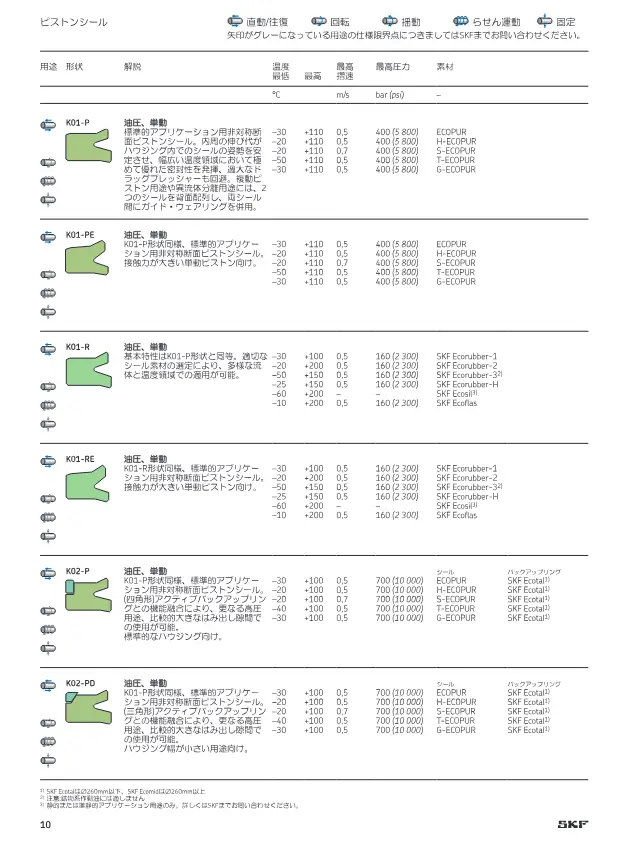
A reduced image of the relevant page is quoted from the document. Copyright belongs to SKF.Request removal
Specifications
| Maximum Pressure | 160~1500 bar |
|---|---|
| Minimum Operating Temperature | -60 °C |
| Maximum Operating Temperature | +260 °C |
| Maximum Sliding Speed | 0.3~15 m/s |
How to choose Piston Seals
Points to check when selecting, with the values for this product (Piston Seal).
-
1. Match cylinder bore and groove dimensions
The seal is designed around the combination of cylinder bore D, piston-side groove diameter d, and groove width L. If these three dimensions do not match, excess or insufficient squeeze (the amount by which the seal is compressed) causes leakage, premature wear, or improper installation. When replacing parts on existing equipment, measure the groove and check whether a matching dimensional series is available.
-
2. Choose single-acting or double-acting by application
Use single-acting types for cylinders pressurized on one side only, and double-acting types for double-acting cylinders pressurized in both directions. Single-acting types often have asymmetric cross-sections, and sealing fails if they are installed in the wrong orientation. Double-acting types generally have symmetric cross-sections and seal pressure in both directions with a single seal.
-
3. Allow margin for maximum pressure
This product: Maximum Pressure 160~1500 barThe listed products have maximum pressures ranging from 25 to 1500 bar. Compare them using the maximum pressure including surge pressure (momentary pressure spikes). At high pressure, extrusion into the clearance gap is more likely, so backup-ring-integrated designs or high-pressure-rated profiles are good candidates.
-
4. Select material by fluid and temperature
Polyurethane-based materials offer excellent wear resistance and pressure resistance and are widely used in hydraulics. PTFE-based materials have low friction and high chemical and heat resistance, making them suitable for chemical and food applications. Rubber-based materials such as NBR are common materials for mineral oil applications. Select a material compatible with the working fluid and temperature range (listed products include examples from -60 to 260°C).
-
5. Check sliding speed and friction characteristics
This product: Maximum Sliding Speed 0.3~15 m/sThe listed products have maximum sliding speeds of 0.3 to 15 m/s. High-speed operation and frequent reciprocating motion increase heat generation and wear. In low-speed positioning, stick-slip (vibration caused by sticking) becomes a concern, so profiles with PTFE-based slide rings, which have low breakaway resistance, are suitable.
-
6. Consider integrating guide functions
Profiles that incorporate guide ring functions allow a shorter piston length and reduce the number of components. However, when lateral loads are high, designs that combine a separate guide ring are common. Select the profile after reviewing the groove configuration and lateral load conditions.
This guide was written by AI based on the listed products' documents and specification items.
Description
Uses ECOPUR-series polyurethane, various elastomers, and PTFE-based materials, and is compatible with linear and reciprocating hydraulic and pneumatic equipment. Operating temperature, maximum pressure, and sliding speed vary by profile. Options include high-pressure, space-saving, and guide-integrated designs.
Features
- Choice of asymmetrical or symmetrical profile
- PTFE construction for low friction and avoidance of stick-slip
- High-pressure capability with backup ring
- Compact guide-integrated design
Applications
- Hydraulic cylinders
- Pneumatic cylinders
- Construction machinery
- Machine tools
- Injection molding machines
- Mining and tunneling equipment
FAQ
- Q. What are the maximum pressure and operating temperature range of the piston seals (e.g., K01-P / K02-P)?
- A. Maximum pressure is 160 to 1500 bar. Operating temperature ranges from a lower limit of -60 °C to an upper limit of +260 °C. Operating temperature, maximum pressure, and sliding speed vary by profile.
- Q. What is the maximum sliding speed of the piston seals?
- A. Maximum sliding speed is 0.3 to 15 m/s. As with operating temperature and maximum pressure, sliding speed varies by profile.
- Q. What materials are available for the piston seals?
- A. ECOPUR-series polyurethane, various elastomers, and PTFE-based materials are used. PTFE types offer low friction and avoid stick-slip.
- Q. How can I select between single-acting, double-acting, asymmetrical, and symmetrical piston seals?
- A. Single-acting or double-acting and symmetrical or asymmetrical profiles can be selected to suit the application. Both asymmetrical and symmetrical profile options are available.
- Q. Are there piston seals for high-pressure use?
- A. High pressure is supported with a backup ring. High-pressure, space-saving, and guide-integrated compact designs are also available.
Written by AI based on the content of the source documents.
Source documents
-
Catalog
カスタムエンジニアリングシール シール製品案内
56 pages Open page 10
Found on: https://azuma-eg.com/catalogue/
Similar products (other manufacturers)
Piston Seals products, ordered by similarity of specifications and applications.
-
Backup Rings
Backup Ring (JIS B 2401 P・G)
PTFE backup ring conforming to JIS B 2401 P・G series. Available in spiral, bias-cut, and endless shapes.
JTEKT Corporation
-
O-Rings
O-Ring
O-rings used for sealing water, oil, air, various gases and chemicals. Available in a wide range of sizes and types.
JTEKT Corporation
More products from SKF
See all →-
Piston Seals
Piston Seal K01–K07・K21 (Lip Type, Compact Seal)
A group of lip-type (U-cup) piston seals with standard housing dimensions matched to cylinder bore and groove diameters.
SKF
-
Piston Seals
Piston Seal K08 (PTFE and O-Ring Combination)
A piston seal combining a PTFE seal and an O-ring, offering low friction and suitable for positioning applications.
SKF
-
Piston Seals
Piston Seal K09 (Double-Acting Compact Type)
Double-acting compact piston seal with guide ring. Excellent static and dynamic sealing performance.
SKF
-
Piston Seals
Machined Seals (Piston Seals)
Piston seals for hydraulic and pneumatic cylinders, machined with SKF SEAL JET. Supports quantities from one piece to small lots, with material selected to suit the application.
SKF
-
Piston Seals
K01-P Piston Seal
Model: K01-P
General-purpose piston seal for single-acting hydraulic cylinders. Asymmetric profile provides high sealing performance over a wide range of conditions.
SKF
-
Piston Seals
K01-PE Piston Seal
Model: K01-PE
Asymmetric profile piston seal for single-acting pistons with high contact force.
SKF