Light Carburized Steel Ball
軽浸炭鋼球 / Tsubaki Nakashima Co., Ltd. (Official website) / Listed on page 14 of the document
A steel ball with a shallower surface carburizing depth, making additional processing such as drilling and welding easier.
Last verified: (date the content was verified against the source document)
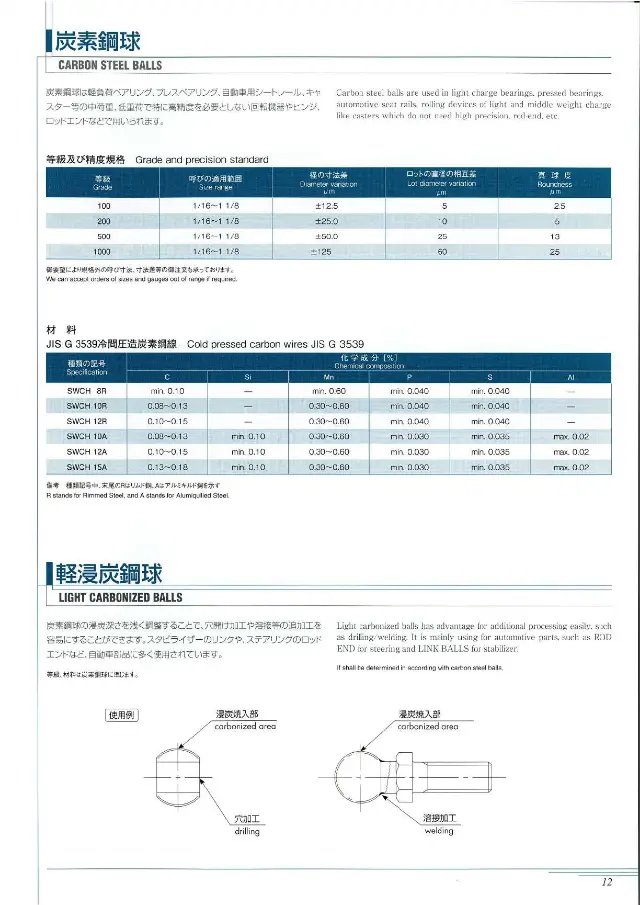
A reduced image of the relevant page is quoted from the document. Copyright belongs to Tsubaki Nakashima Co., Ltd..Request removal
How to choose Ball
Points to check when selecting, with the values for this product (Light Carburized Steel Ball).
-
1. Select the material to suit the application
Bearing steel is used for high-load bearings, stainless steel where corrosion resistance is required, and carbon steel for light-load, low-cost applications. For high-speed bearings or vacuum environments that require light weight, non-magnetic properties or electrical insulation, silicon nitride is suitable; resin and glass are candidates for applications in contact with chemicals or where anti-rust oil cannot be used.
-
2. Determine the accuracy grade by required performance
Grades are indicated as G3 to G1000 and others; a smaller number means smaller variation in sphericity and diameter. For low-noise, high-speed bearings such as machine tool spindles, select a smaller grade; for casters and light-load applications, select a larger grade to avoid over-specification.
-
3. Check nominal diameter and inch designations
The nominal diameters of listed products range from 0.3 to 101.6 mm. Many inch-based nominal diameters are also available, such as 1/4 inch = 6.35 mm, so confirm whether the design values are metric or inch, and specify a size that matches the raceway groove and cage dimensions.
-
4. Evaluate rotational quality by sphericity and surface roughness
Sphericity (2.5 to 25 μm for listed products) and surface roughness Ra (0.01 to 0.15 μm) directly affect vibration, noise and wear. When used as valve seals or reference spheres for measurement, confirm that these two values meet the required accuracy.
-
5. Check hardness and operating temperature
Hardness relates to wear resistance and resistance to indentation, and is indicated in HRC or HV. For high-temperature use, check the maximum operating temperature (288 to 1000 °C for listed products) and hot hardness. Cemented carbide and ceramics tend to retain hardness at high temperatures.
-
6. Confirm whether secondary processing is possible
Standard hardened steel balls are very hard, making drilling and welding difficult. For applications such as ball joints, where a shaft is welded to the ball or holes are drilled, select machinable products such as lightly carburized steel balls with shallower case depth, or cut balls with flat surfaces for retention.
This guide was written by AI based on the listed products' documents and specification items.
Description
A carbon steel ball whose carburizing depth is adjusted to facilitate post-processing. Widely used in automotive parts such as stabilizer links and steering rod ends.
Features
- Easy drilling
- Weldable
Applications
- Automotive parts
- Stabilizer links
- Steering rod ends
FAQ
- Q. What processing is the Light Carburized Steel Ball suitable for?
- A. It is a steel ball with a shallower surface carburizing depth, making additional processing such as drilling and welding easier. It allows easy drilling and can also be welded.
- Q. What applications is the Light Carburized Steel Ball used for?
- A. It is widely used in automotive parts such as stabilizer links and steering rod ends.
Written by AI based on the content of the source documents.
Source documents
-
Catalog
ツバキ・ナカシマ精密ボール 製品カタログ
25 pages Open page 14
Found on: https://azuma-eg.com/catalogue/
Similar products (other manufacturers)
Ball products, ordered by similarity of specifications and applications.
-
Ball
Silicon Nitride Ceramic Ball (G5 NCR)
Model: 5/32 G5 NCR
Lightweight, non-magnetic, high-heat-resistant silicon nitride ceramic ball. Available in diameters from approximately 0.8 mm to 38.1 mm.
JTEKT Corporation
-
Ball
Ceramic Ball (Silicon Nitride)
Silicon nitride ceramic ball. Excellent wear and galling resistance and corrosion resistance, with light weight, non-magnetic and insulating properties. Nominal diameters range from 0.8 mm to 1.5 inches (38.1 mm).
JTEKT Corporation
More products from Tsubaki Nakashima Co., Ltd.
See all →-
Ball
Rolling Bearing Steel Balls
High-load, high-precision, low-noise steel balls for bearings in automobiles, motorcycles, machine tools and home appliances. Compliant with JIS B1501, with grades 3 to 200 available.
Tsubaki Nakashima Co., Ltd.
-
Ball
Carbon Steel Balls
Carbon steel balls for light-load bearings, casters, and similar applications. Available in four grades, 100 to 1000.
Tsubaki Nakashima Co., Ltd.
-
Ball
Stainless Steel Balls
Standard balls made of martensitic, ferritic, and austenitic stainless steel. Selectable according to corrosion resistance and hardness.
Tsubaki Nakashima Co., Ltd.
-
Ball
Non-Ferrous Metal Balls (Copper Alloy Balls and Aluminum Alloy Balls)
Non-ferrous metal balls made of brass, beryllium copper, phosphor bronze, bronze, and aluminum alloy. Used in applications such as the food industry.
Tsubaki Nakashima Co., Ltd.
-
Ball
Cemented Carbide Ball (Tungsten Carbide Ball)
Cemented carbide ball that maintains hardness at high temperatures. Used for ballpoint pens and other applications.
Tsubaki Nakashima Co., Ltd.
-
Ball
Plastic Balls
Plastic balls precision-ground after injection molding. Lighter than metal balls and requires no anti-rust oil.
Tsubaki Nakashima Co., Ltd.