Ceramic Ball (Silicon Nitride)
セラミックボール / JTEKT Corporation (Official website) / Listed on page 16 of the document
Silicon nitride ceramic ball. Excellent wear and galling resistance and corrosion resistance, with light weight, non-magnetic and insulating properties. Nominal diameters range from 0.8 mm to 1.5 inches (38.1 mm).
Last verified: (date the content was verified against the source document)
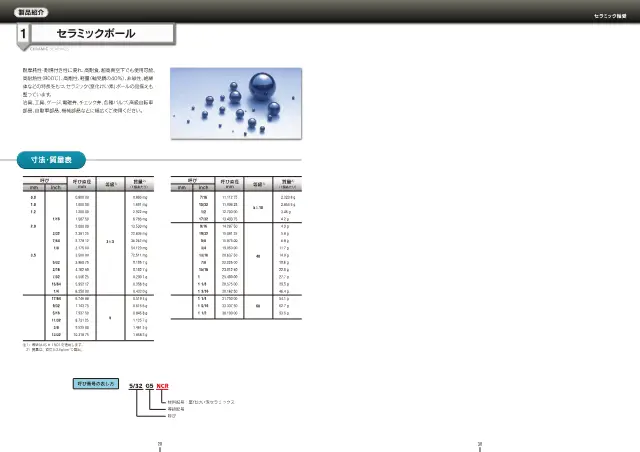
A reduced image of the relevant page is quoted from the document. Copyright belongs to JTEKT Corporation.Request removal
Specifications
| Material | Silicon nitride ceramics |
|---|---|
| Maximum Operating Temperature | 800 ℃ |
| Nominal diameter Dw | 0.8~38.1 mm |
| Mass per unit | 0.866 mg |
| Specific Gravity (Density) | 3.23 g/cm3 |
| Applicable Standards | JIS B 1501 |
セラミックボール model comparison
Compare 2 models in the same series by specification.
| Model | Mass per unit |
|---|---|
| セラミックボール(窒化けい素) This product | 0.866 mg |
| 5/32 G5 NCR | 1.691 mg |
How to choose Ball
Points to check when selecting, with the values for this product (Ceramic Ball (Silicon Nitride)).
-
1. Select the material to suit the application
This product: Material Silicon nitride ceramicsBearing steel is used for high-load bearings, stainless steel where corrosion resistance is required, and carbon steel for light-load, low-cost applications. For high-speed bearings or vacuum environments that require light weight, non-magnetic properties or electrical insulation, silicon nitride is suitable; resin and glass are candidates for applications in contact with chemicals or where anti-rust oil cannot be used.
-
2. Determine the accuracy grade by required performance
Grades are indicated as G3 to G1000 and others; a smaller number means smaller variation in sphericity and diameter. For low-noise, high-speed bearings such as machine tool spindles, select a smaller grade; for casters and light-load applications, select a larger grade to avoid over-specification.
-
3. Check nominal diameter and inch designations
This product: Nominal diameter Dw 0.8~38.1 mmThe nominal diameters of listed products range from 0.3 to 101.6 mm. Many inch-based nominal diameters are also available, such as 1/4 inch = 6.35 mm, so confirm whether the design values are metric or inch, and specify a size that matches the raceway groove and cage dimensions.
-
4. Evaluate rotational quality by sphericity and surface roughness
Sphericity (2.5 to 25 μm for listed products) and surface roughness Ra (0.01 to 0.15 μm) directly affect vibration, noise and wear. When used as valve seals or reference spheres for measurement, confirm that these two values meet the required accuracy.
-
5. Check hardness and operating temperature
This product: Maximum Operating Temperature 800 ℃Hardness relates to wear resistance and resistance to indentation, and is indicated in HRC or HV. For high-temperature use, check the maximum operating temperature (288 to 1000 °C for listed products) and hot hardness. Cemented carbide and ceramics tend to retain hardness at high temperatures.
-
6. Confirm whether secondary processing is possible
Standard hardened steel balls are very hard, making drilling and welding difficult. For applications such as ball joints, where a shaft is welded to the ball or holes are drilled, select machinable products such as lightly carburized steel balls with shallower case depth, or cut balls with flat surfaces for retention.
This guide was written by AI based on the listed products' documents and specification items.
Description
Ball made of silicon nitride ceramics, offering high heat resistance (800 ℃), high rigidity, and usability under ultra-high vacuum. Approximately 40% of the mass of bearing steel, making it lightweight. Used in jigs, tools, gauges, solenoid valves, check valves, various valves, automotive parts, and similar applications. Grades comply with JIS B 1501, and the designation is expressed as "nominal diameter grade symbol material symbol." Mass is calculated using a density of 3.23 g/cm3.
Features
- Excellent wear and galling resistance
- High corrosion resistance
- Usable under ultra-high vacuum
- High heat resistance (800 ℃)
- High rigidity
- Lightweight (40% of bearing steel)
- Non-magnetic
- Insulating
Applications
- Jigs
- Tools
- Gauges
- Solenoid valves
- Check valves
- Various valves
- High-end bicycle parts
- Automotive parts
- Machine parts
FAQ
- Q. What is the upper limit of the operating temperature for the Ceramic Ball (Silicon Nitride)?
- A. It has high heat resistance, with a maximum operating temperature of 800 ℃.
- Q. What applications can the Ceramic Ball (Silicon Nitride) be used for?
- A. It is used in jigs, tools, gauges, solenoid valves, check valves, various valves, high-end bicycle parts, automotive parts, machine parts, and similar applications.
- Q. What is the range of nominal diameters and the grade standard for the Ceramic Ball (Silicon Nitride)?
- A. Nominal diameter Dw is available from 0.8 to 38.1 mm (1.5 inches). Grades comply with JIS B 1501, and the designation is expressed as "nominal diameter grade symbol material symbol."
- Q. Is the Ceramic Ball (Silicon Nitride) lightweight? What are its weight and density?
- A. It is lightweight, with a mass of approximately 40% of bearing steel. Its specific gravity (density) is 3.23 g/cm3, and the mass per ball is 0.866 mg.
- Q. Can the Ceramic Ball (Silicon Nitride) be used under ultra-high vacuum or in environments involving magnetism or electricity?
- A. It can be used under ultra-high vacuum. It is non-magnetic and also has insulating properties.
Written by AI based on the content of the source documents.
Source documents
- Catalog 特殊環境用軸受シリーズ セラミック軸受 Open page 16
Similar products (other manufacturers)
Ball products, ordered by similarity of specifications and applications.
-
Ball
Plastic Balls
Plastic balls precision-ground after injection molding. Lighter than metal balls and requires no anti-rust oil.
Tsubaki Nakashima Co., Ltd.
-
Ball
Rolling Bearing Steel Balls (SUJ2・SUS440C)
Rolling bearing steel balls made of SUJ2・SUS440C. Nominal diameter from 0.4 mm to 101.6 mm.
Tsubaki Nakashima Co., Ltd.
More products from JTEKT Corporation
See all →-
Ball
Silicon Nitride Ceramic Ball (G5 NCR)
Model: 5/32 G5 NCR
Lightweight, non-magnetic, high-heat-resistant silicon nitride ceramic ball. Available in diameters from approximately 0.8 mm to 38.1 mm.
JTEKT Corporation
-
Ball
Ceramic Ball
A ball made of silicon nitride, a bearing component characterized by light weight and high rigidity.
JTEKT Corporation
-
Deep Groove Ball Bearings
Deep Groove Ball Bearing
Single-row ball bearing that accepts radial load and axial load in both directions. Suitable for high-speed rotation and low-vibration applications. Dimension tables cover bore diameters from 100 to 1420 mm.
JTEKT Corporation
-
Angular Contact Ball Bearings
Angular Contact Ball Bearing
Angular contact ball bearings that accept axial loads in one or both directions depending on contact angle. Available as single row and back-to-back or face-to-face combinations (DB, DF), with bore diameters of approximately 100 to 300 mm.
JTEKT Corporation
-
Angular Contact Ball Bearings
Single-Row and Matched-Set Angular Contact Ball Bearings
Large single-row and matched-set angular contact ball bearings with bore diameters of 310 to 670 mm. Capable of simultaneously supporting radial and axial loads.
JTEKT Corporation
-
Angular Contact Ball Bearings
Double-Row Angular Contact Ball Bearing
Double-row angular contact ball bearing with a bore diameter of 120 to 280 mm. Accepts radial and axial loads in both directions.
JTEKT Corporation