Angular Contact Ball Bearing
単列・組合せアンギュラ玉軸受 / JTEKT Corporation (Official website) / Listed on page 62 of the document
Angular contact ball bearings that accept axial loads in one or both directions depending on contact angle. Available as single row and back-to-back or face-to-face combinations (DB, DF), with bore diameters of approximately 100 to 300 mm.
Last verified: (date the content was verified against the source document)
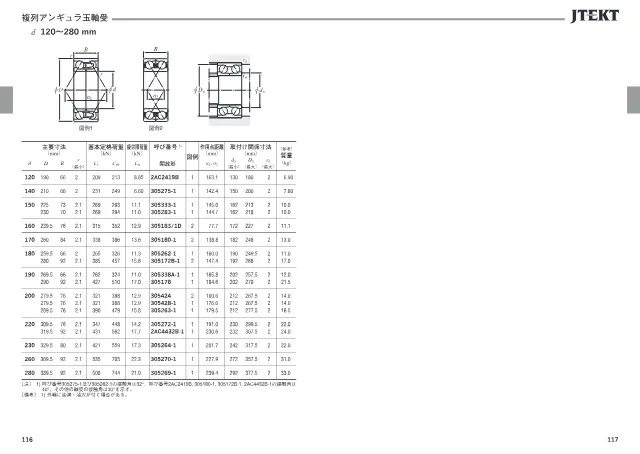
A reduced image of the relevant page is quoted from the document. Copyright belongs to JTEKT Corporation.Request removal
Specifications
| Contact Angle α | 15・30・40 ° |
|---|---|
| Permissible tilt angle | 0.0006 rad |
| Inner diameter d | 100~300 mm |
単列・組合せアンギュラ玉軸受 model comparison
Compare 2 models in the same series by specification.
| Model | Inner diameter d |
|---|---|
| アンギュラ玉軸受 This product | 100~300 mm |
| 単列・組合せアンギュラ玉軸受 | 310~670 mm |
How to choose Angular Contact Ball Bearings
Points to check when selecting, with the values for this product (Angular Contact Ball Bearing).
-
1. Determine Axial Load Capacity by Contact Angle
This product: Contact Angle α 15・30・40 °A larger contact angle increases axial load capacity and axial rigidity, while a smaller contact angle is better suited to high-speed rotation. Listed products have contact angles of 15° to 60°, with 15°, 30°, and 40° being common. Large contact angles are used for ball screw support applications. Select based on the load ratio and rotational speed.
-
2. Select a Combination Configuration Suited to the Load Direction
DB arrangements withstand moment loads well and easily increase shaft rigidity, while DF arrangements readily tolerate tilt caused by mounting errors. DT arrangements share large one-directional axial loads across multiple rows. If axial loads act in both directions, DB or DF arrangements or double-row types are required.
-
3. Check Main Dimensions Matching the Shaft and Housing
This product: Inner diameter d 100~300 mmMatch the bore to the shaft diameter and the outside diameter to the housing bore diameter. Listed products have bore diameters of 30 to 670 mm and outside diameters of 55 to 900 mm. Confirm that the width, including the total width of combined units, fits the available axial space.
-
4. Verify Life Using Basic Dynamic Load Rating
The basic dynamic load rating Cr is the reference value for rated life calculations, and listed products range from 18.9 to 191 kN. Calculate the dynamic equivalent load from radial and axial loads and confirm that the required life is met. If impact or large loads during stops are present, also check the basic static load rating.
-
5. Permissible Rotational Speed by Lubrication Method
The permissible rotational speed differs between grease lubrication and oil lubrication, with oil lubrication set higher. Larger combinations or preloads increase heat generation and reduce practical speed, so confirm that there is sufficient margin in the operating speed together with the lubrication method.
-
6. Precision Class and Cage Selection by Application
General industrial machinery uses JIS Class 0, while locations requiring rotational accuracy, such as machine tool spindles, use high-precision grades such as Class 5 or Class 4. Cages are available in steel plate, resin, and machined brass types; confirm the material against the required high-speed capability, heat resistance, and lubrication conditions.
This guide was written by AI based on the listed products' documents and specification items.
Description
Contact angles can be selected from 15, 30, or 40 degrees. A larger contact angle provides higher axial load capacity, while a smaller contact angle is suited to high-speed rotation. Single row bearings have a small permissible misalignment angle, and combined and multi-row bearings do not permit misalignment. Internal clearance and cage types are also listed.
Features
- Single row bearings accept axial load in one direction
- Combined (DB, DF) and multi-row bearings accept axial load in both directions
- Contact angles of 15, 30, and 40 degrees selectable
- Machined brass cage as standard
Applications
- Machine tool spindles
- Pumps and compressors
- General industrial machinery
FAQ
- Q. From which contact angles can angular contact ball bearings be selected?
- A. Contact angles can be selected from 15, 30, or 40 degrees. A larger contact angle provides higher axial load capacity, while a smaller contact angle is suited to high-speed rotation.
- Q. In which directions can single row and combined or multi-row angular contact ball bearings accept axial load?
- A. Single row bearings accept axial load in one direction. Combined (DB, DF) and multi-row bearings accept axial load in both directions.
- Q. How does the permissible misalignment differ between single row and combined angular contact ball bearings?
- A. Single row bearings have a small permissible misalignment angle, and combined and multi-row bearings do not permit misalignment. The permissible misalignment angle of single row bearings is 0.0006 rad.
- Q. What are the target bore dimensions and main applications of angular contact ball bearings?
- A. Bore diameter d is listed in the range of approximately 100 to 300 mm. Applications include machine tool spindles, pumps and compressors, and general industrial machinery.
Written by AI based on the content of the source documents.
Source documents
Similar products (other manufacturers)
Angular Contact Ball Bearings products, ordered by similarity of specifications and applications.
-
Tapered Roller Bearings
Back-to-Back Tapered Roller Bearings
Back-to-back tapered roller bearings with bore diameters of 40 to 180 mm. Dimension table listing dimensions, basic load ratings, and limiting speeds.
SKF
-
Tapered Roller Bearings
Back-to-Back Tapered Roller Bearings (Bore Diameter 190–260 mm)
Back-to-back tapered roller bearings with bore diameters of 190–260 mm. Dimension table listing dimensions and basic load ratings.
SKF
-
Needle roller bearings
Needle Roller Bearing with Angular Contact Ball Bearing
Model: NKIA59
Needle roller bearing with an angular contact ball bearing that supports radial load and unidirectional axial load. Dimension series 59.
NTN Corporation
-
Needle roller bearings
Needle Roller Bearing with Cage
Needle roller bearing with a cage that guides the rollers. Small diameter with high load capacity, low friction, suitable for high-speed rotation. Also suitable for oscillating applications.
NTN Corporation
-
Cylindrical Roller Bearings
RCC Bearing (Sealed Cylindrical Roller Bearing for Railway Vehicle Axle Boxes)
A sealed double-row cylindrical roller bearing unit for railway vehicle axle boxes. Seals at both ends and long-life grease enhance maintainability and reliability.
NSK
More products from JTEKT Corporation
See all →-
Angular Contact Ball Bearings
Single-Row and Matched-Set Angular Contact Ball Bearings
Large single-row and matched-set angular contact ball bearings with bore diameters of 310 to 670 mm. Capable of simultaneously supporting radial and axial loads.
JTEKT Corporation
-
Angular Contact Ball Bearings
Double-Row Angular Contact Ball Bearing
Double-row angular contact ball bearing with a bore diameter of 120 to 280 mm. Accepts radial and axial loads in both directions.
JTEKT Corporation
-
Angular Contact Ball Bearings
Precision Ball Screw Support Bearing
High-rigidity, high-precision support bearing that supports ball screws in machine tools. Available in double-seal and single-seal types, and compatible with 2 to 4 row combinations.
JTEKT Corporation
-
Angular Contact Ball Bearings
Precision Ball Screw Support Bearing Unit
A high-rigidity support bearing unit combining precision support bearings with a precision-machined housing, designed for easy installation.
JTEKT Corporation
-
Angular Contact Ball Bearings
High-Speed Combined Angular Contact Ball Bearing ACT000DB/BDB Series
High-speed combined angular contact ball bearing for axial load support in machine tool spindles. Contact angles of 30° and 40° are available, with bore diameters of 30 to 170 mm. Used in combination with NN3000 series cylindrical roller bearings.
JTEKT Corporation
-
Deep Groove Ball Bearings
Deep Groove Ball Bearing
Single-row ball bearing that accepts radial load and axial load in both directions. Suitable for high-speed rotation and low-vibration applications. Dimension tables cover bore diameters from 100 to 1420 mm.
JTEKT Corporation