JHS Series Self-Aligning Roller Bearing
JHSシリーズ / JTEKT Corporation (Official website) / Listed on page 2 of the document
Heavy-load self-aligning roller bearing for roll support in continuous casting equipment. Uses developed steel and optimized internal design to improve wear resistance and rated load capacity.
Last verified: (date the content was verified against the source document)
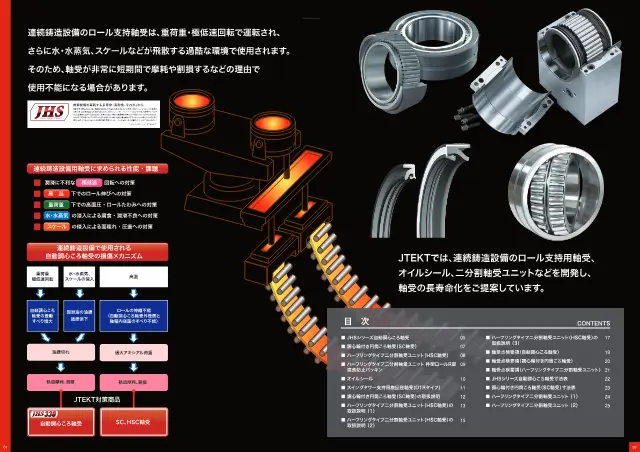
A reduced image of the relevant page is quoted from the document. Copyright belongs to JTEKT Corporation.Request removal
Specifications
| Dynamic load rating (compared with conventional) | Max. 1.15 倍 |
|---|---|
| 静定格荷重(従来比) | Max. 1.30 倍 |
| Maximum Contact Stress | 1450 MPa |
| Wear Depth (Bench Test) | 1.4 μm |
How to choose Self-aligning ball bearings
Points to check when selecting, with the values for this product (JHS Series Self-Aligning Roller Bearing).
-
1. Select size by shaft diameter and mounting space
Bore diameter d is determined by the shaft diameter, while outside diameter D and width B are determined by the housing fit. Listed products cover bore diameters of 35 to 380 mm, outside diameters of 80 to 650 mm and widths of 28 to 200 mm. Even with the same bore, outside diameter and width vary by series, so verify all three dimensions together.
-
2. Choose dimension series for load capacity and size
The series designation (222, 223, 230, etc.) indicates the width-to-outside-diameter ratio. In general, larger outside diameter and width series such as 223 offer higher load capacity, while narrow-width series such as 230 suit space-limited installations. Select the series based on load conditions and available mounting space.
-
3. Verify required life using basic dynamic load rating
The basic dynamic load rating Cr is the reference value for life calculation. For roller bearings, life is proportional to the load ratio raised to the 10/3 power. Calculate the rated life from equivalent load and rotational speed, and confirm it meets the required life. High-load design products rated at 1.15 times conventional products are candidates where longer life is needed within the same dimensions.
-
4. Evaluate heavy loads at standstill or low speed using static load rating
For applications such as continuous casting rolls or heavy material transfer equipment that experience large loads or shocks at low speed or under oscillation, evaluate using the static safety factor against the basic static load rating C0r. To prevent permanent deformation (indentations) of the raceways, check the ratio of maximum load to C0r.
-
5. Match bore type to the mounting method
Cylindrical bores are fitted to the shaft with interference fit, while tapered bores can be secured to shafts without shoulders using adapter or withdrawal sleeves. With tapered bores, internal clearance decreases as the bearing is driven onto the sleeve, so also confirm the compatible sleeve model and assembly dimensions.
-
6. Specify internal clearance suited to operating temperature
Clearance decreases when the inner ring runs hotter than the outer ring or when the interference fit is large. Determine whether normal clearance CN is sufficient or whether a larger clearance such as C3 is required, based on fit, temperature difference and drive-up amount for tapered bores.
This guide was written by AI based on the listed products' documents and specification items.
Description
Developed steel is applied to the outer ring, with fine precipitate control and high hardness improving wear resistance. The maximum rated load design, reduced contact stress, and stabilized roller orientation provide up to 1.15 times the dynamic basic load rating and up to 1.30 times the static basic load rating compared with conventional products. Bench wear tests confirmed wear resistance of 1.5 times or more compared with conventional bearings.
Features
- Improved wear resistance through developed steel and special heat treatment
- High rated load capacity from maximum rated load design
- Internal design that reduces contact stress
- Reduced induced axial load and guide ring wear through stabilized roller orientation
Applications
- Roll support in continuous casting equipment
FAQ
- Q. What applications can the JHS Series self-aligning roller bearing be used for?
- A. It is used for roll support in continuous casting equipment. It is a self-aligning roller bearing that supports heavy loads.
- Q. How much has the rated load of the JHS Series self-aligning roller bearing improved compared with conventional products?
- A. Compared with conventional products, the dynamic basic load rating is up to 1.15 times higher and the static basic load rating is up to 1.30 times higher. These improvements result from the maximum rated load design, reduced contact stress, and stabilized roller orientation.
- Q. How has the wear resistance of the JHS Series self-aligning roller bearing been improved?
- A. Developed steel is applied to the outer ring, and fine precipitate control and high hardness improve wear resistance. Bench wear tests confirmed wear resistance of 1.5 times or more compared with conventional bearings. The wear depth (bench test) is 1.4 μm.
- Q. What is the maximum contact stress of the JHS Series self-aligning roller bearing?
- A. The maximum contact stress is 1450 MPa. Contact stress is reduced by the internal design.
- Q. How is guide ring wear suppressed in the JHS Series self-aligning roller bearing?
- A. Stabilizing the roller orientation reduces induced axial load and guide ring wear.
Written by AI based on the content of the source documents.
Source documents
- Catalog 連続鋳造設備用軸受と関連商品 Open page 2
Similar products (other manufacturers)
Self-aligning ball bearings products, ordered by similarity of specifications and applications.
-
Self-aligning ball bearings
SKF Explorer Spherical Roller Bearing 24026-2CS2/VT143
Model: 24026-2CS2/VT143
Sealed spherical roller bearing. Used for verification examples of dynamic and static loads in heavy material handling equipment in steel plants.
SKF
-
Self-aligning ball bearings
Sealed Spherical Roller Bearings and Adapter Sleeves
Dimensions and masses of sealed spherical roller bearings and adapter sleeve combinations with bore diameters of 35 to 380 mm. SKF Explorer bearings.
SKF
-
Cylindrical Roller Bearings
RCC Bearing (Sealed Cylindrical Roller Bearing for Railway Vehicle Axle Boxes)
A sealed double-row cylindrical roller bearing unit for railway vehicle axle boxes. Seals at both ends and long-life grease enhance maintainability and reliability.
NSK
-
Needle roller bearings
Needle Roller Bearing with Cage
Needle roller bearing with a cage that guides the rollers. Small diameter with high load capacity, low friction, suitable for high-speed rotation. Also suitable for oscillating applications.
NTN Corporation
-
Needle roller bearings
Full Complement Drawn Cup Needle Roller Bearing
A needle roller bearing without a cage, with a large number of rollers to achieve high load capacity. Suitable for high-load, low-speed, and oscillating applications.
NTN Corporation
More products from JTEKT Corporation
See all →-
Deep Groove Ball Bearings
Deep Groove Ball Bearing
Single-row ball bearing that accepts radial load and axial load in both directions. Suitable for high-speed rotation and low-vibration applications. Dimension tables cover bore diameters from 100 to 1420 mm.
JTEKT Corporation
-
Angular Contact Ball Bearings
Angular Contact Ball Bearing
Angular contact ball bearings that accept axial loads in one or both directions depending on contact angle. Available as single row and back-to-back or face-to-face combinations (DB, DF), with bore diameters of approximately 100 to 300 mm.
JTEKT Corporation
-
Angular Contact Ball Bearings
Single-Row and Matched-Set Angular Contact Ball Bearings
Large single-row and matched-set angular contact ball bearings with bore diameters of 310 to 670 mm. Capable of simultaneously supporting radial and axial loads.
JTEKT Corporation
-
Angular Contact Ball Bearings
Double-Row Angular Contact Ball Bearing
Double-row angular contact ball bearing with a bore diameter of 120 to 280 mm. Accepts radial and axial loads in both directions.
JTEKT Corporation
-
Cylindrical Roller Bearings
Single-Row Cylindrical Roller Bearing
Single-row cylindrical roller bearing with bore diameter 100 to 850 mm. High radial load capacity, suitable for heavy and shock loads.
JTEKT Corporation
-
Cylindrical Roller Bearings
Double-Row Cylindrical Roller Bearings
Double-row cylindrical roller bearings with bore diameters of 100 to 670 mm. Available with cylindrical bore and tapered bore; tapered bore bearings achieve the specified clearance through drive-up amount.
JTEKT Corporation