O-Ring (JASO F 404, for Reciprocating and Static Use)
JASO F 404 / JTEKT Corporation (Official website) / Listed on page 91 of the document
O-ring compliant with JASO F 404 standard for reciprocating and static sealing applications. Available in many designation numbers by combination of inside diameter and cross-section.
Last verified: (date the content was verified against the source document)
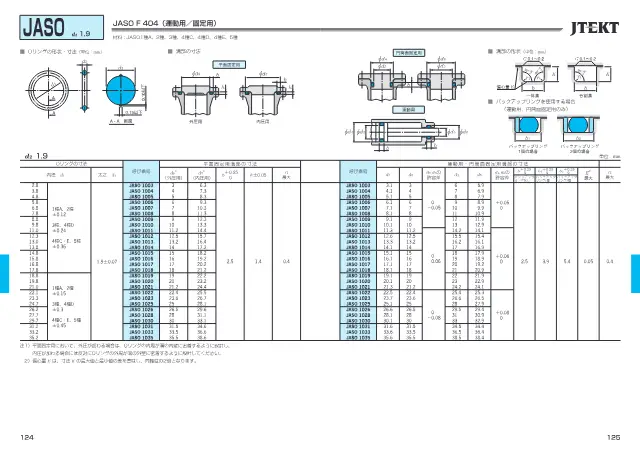
A reduced image of the relevant page is quoted from the document. Copyright belongs to JTEKT Corporation.Request removal
Specifications
| Wire thickness d2 | 1.9, 2.4, 3.5 mm |
|---|---|
| Inner diameter d1 | 2.8~35.2 mm |
How to choose O-Rings
Points to check when selecting, with the values for this product (O-Ring (JASO F 404, for Reciprocating and Static Use)).
-
1. Specify dimensions by standard and size number
For series such as JIS B 2401 P and G, JASO F 404, and AS 568, the inner diameter, cross-section diameter, and recommended groove dimensions are defined for each size number. Confirm which standard series the equipment groove is designed to, and select a size number from the same series to avoid dimensional mismatch with the groove.
-
2. Select an inner diameter that suits the groove and shaft diameter
This product: Inner diameter d1 2.8~35.2 mmSelect the inner diameter d1 to match the diameter of the shaft or groove bottom it fits onto. For applications sealing the outer periphery, the O-ring is generally installed with slight stretch over the shaft; for applications sealing the inner periphery, it is generally fitted along the bore side. Excessive stretch thins the cross-section and reduces squeeze.
-
3. Check the cross-section diameter against groove depth
This product: Wire thickness d2 1.9, 2.4, 3.5 mmThe relationship between cross-section diameter d2 (wire diameter) and groove depth determines the squeeze. Even with the same inner diameter, some series have different cross-section diameters, so select a wire diameter that suits the groove depth and width. The cross-section diameters of the listed products range from 1.02 to 10 mm.
-
4. Select a material suited to the fluid and temperature
NBR is suitable for mineral-oil-based hydraulic fluids; FKM for heat and chemical resistance; and EPDM for water, steam, and brake fluid, but it is not suitable for mineral oils. VMQ (silicone) can be used from low to high temperatures, but its mechanical strength is lower. Confirm the fluid type and operating temperature range together.
-
5. Select hardness according to pressure
Hardness (Durometer A) is generally around 70 as standard; at higher pressures, selecting a harder material helps suppress extrusion into the gap. However, a harder material requires greater force to compress and slightly reduces sealing performance at low pressure.
-
6. Use backup rings under high pressure
In high-pressure or dynamic applications, the O-ring may extrude into the gap and be damaged. Prevent this by installing backup rings, such as those made of PTFE, on the side opposite the pressurized side. Use one for single-side pressure, or two when pressure acts from both sides, and widen the groove width to accommodate their thickness.
This guide was written by AI based on the listed products' documents and specification items.
Description
Standard O-ring for automotive components with three cross-section series: 1.9 mm, 2.4 mm and 3.5 mm. Specifies groove dimensions for face seal, cylindrical surface seal, and reciprocating motion applications, and also shows examples of backup ring usage. Material is standard material of JIS Grade 1 A through Grade 5.
Features
- Three cross-section series: 1.9 mm, 2.4 mm and 3.5 mm
- Compatible with backup rings for external and internal pressure use
- Specifies groove dimensions and eccentricity tolerances
Applications
- Automotive components
- Hydraulic equipment
- Seals for reciprocating and static parts
FAQ
- Q. What cross-section series are available for the JASO F 404 O-ring (without model number)?
- A. Cross-section series of 1.9 mm, 2.4 mm and 3.5 mm are available. Cross-section d2 is 1.9, 2.4, 3.5 mm.
- Q. What is the inside diameter range of the JASO F 404 O-ring, and what static and reciprocating applications can it be used for?
- A. Inside diameter d1 ranges from 2.8 to 35.2 mm, and there are many designation numbers based on combinations of inside diameter and cross-section. Groove dimensions for face seal, cylindrical surface seal, and reciprocating motion are specified, and it is used for sealing reciprocating and static parts.
- Q. What is the material standard of the JASO F 404 O-ring, and how does it work with backup rings?
- A. The material is standard material of JIS Grade 1 A through Grade 5. It is compatible with backup rings for external and internal pressure use, and examples of backup ring usage are also shown.
Written by AI based on the content of the source documents.
Source documents
- Catalog オイルシール & Oリング Open page 91
Similar products (other manufacturers)
O-Rings products, ordered by similarity of specifications and applications.
-
O-Rings
O-Ring (Recommended Housing Dimensions for Static Applications)
Shows recommended groove dimensions and backup ring configurations for static-application O-rings with cord diameters of 1.5 to 10 mm.
SKF
-
O-Rings
O-Ring (Static Application Recommended Housing Dimensions)
Recommended housing dimensions for static-application O-rings, including combined dimensions with backup rings. Covers cross-section diameters of 1.5 to 10 mm.
SKF
More products from JTEKT Corporation
See all →-
O-Rings
O-Ring
O-rings used for sealing water, oil, air, various gases and chemicals. Available in a wide range of sizes and types.
JTEKT Corporation
-
O-Rings
O-Rings and Backup Rings
O-rings by material, including NBR, FKM and EPDM, that conform to standards, and PTFE backup rings. Selected according to application requirements such as oil resistance, heat resistance and chemical resistance.
JTEKT Corporation
-
O-Rings
O-Ring (AS 568 Aerospace Hydraulic)
O-ring for aerospace hydraulics compliant with AS 568, covering cross-section diameters from 1.02 mm to 6.98 mm.
JTEKT Corporation
-
Deep Groove Ball Bearings
Deep Groove Ball Bearing
Single-row ball bearing that accepts radial load and axial load in both directions. Suitable for high-speed rotation and low-vibration applications. Dimension tables cover bore diameters from 100 to 1420 mm.
JTEKT Corporation
-
Angular Contact Ball Bearings
Angular Contact Ball Bearing
Angular contact ball bearings that accept axial loads in one or both directions depending on contact angle. Available as single row and back-to-back or face-to-face combinations (DB, DF), with bore diameters of approximately 100 to 300 mm.
JTEKT Corporation
-
Angular Contact Ball Bearings
Single-Row and Matched-Set Angular Contact Ball Bearings
Large single-row and matched-set angular contact ball bearings with bore diameters of 310 to 670 mm. Capable of simultaneously supporting radial and axial loads.
JTEKT Corporation