Bearee™ Resin Material Standard Products (Sheet, Rod, Pipe, Plate)
樹脂素材標準品 / NTN Corporation (Official website) / Listed on page 17 of the document
Standard products of Bearee™ material in sheet, rod, pipe, and plate forms.
Last verified: (date the content was verified against the source document)
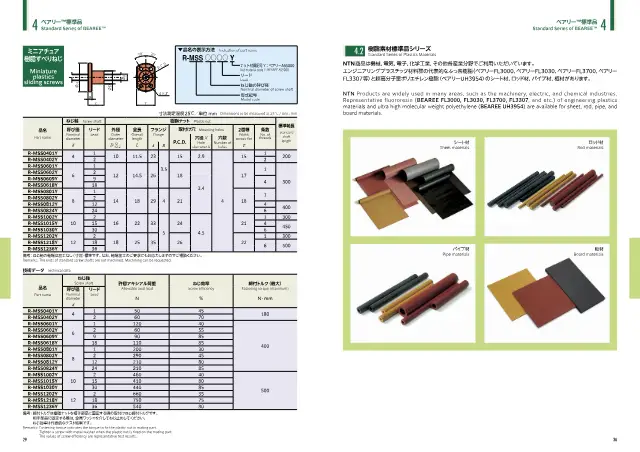
A reduced image of the relevant page is quoted from the document. Copyright belongs to NTN Corporation.Request removal
How to choose Plain Bearings
Points to check when selecting, with the values for this product (Bearee™ Resin Material Standard Products (Sheet, Rod, Pipe, Plate)).
-
1. Select dimensions that fit the shaft diameter and housing bore
Match the inside diameter d to the shaft diameter and the outside diameter D to the housing bore diameter. Listed products have inside diameters of 3 to 70 mm and outside diameters of 5 to 80 mm. When press-fitting, allow for the bearing shrinking during installation, which reduces the inside diameter. Also check the shaft and housing tolerances recommended by the manufacturer.
-
2. Verify bearing pressure and speed using the PV value
Confirm that the PV value, which is the product of bearing pressure (load divided by projected area) and sliding speed, does not exceed the limiting PV value. The limiting PV value of listed products is 400 MPa·m/min. The individual limits for bearing pressure alone (3 to 10 MPa) and for sliding speed alone (150 m/min) must also be satisfied.
-
3. Determine the length according to the load
Increasing the length L increases the projected area and lowers the bearing pressure. However, if the length is too great, shaft deflection tends to concentrate the load at the ends, causing edge loading. Listed products have lengths of 3 to 60 mm, so select a length that keeps the bearing pressure within the limit.
-
4. Select a material suited to the operating environment
For underwater or chemical-liquid use, choose a material with chemical resistance and wear resistance in liquid. Where static electricity is a concern, choose a conductive material. Wear of the mating material also varies with the material and hardness of the mating shaft. If antistatic performance is required, also check the volume resistivity.
-
5. Check temperature and operating clearance
Resin bearings expand as temperature rises, which reduces clearance. In addition to the maximum operating temperature (300 to 350 °C) and continuous operating temperature (260 °C), maintain the recommended minimum operating clearance (0.095 to 0.195 mm).
-
6. Match the lubrication method to the maintenance conditions
Whether a bearing can run without lubrication, or requires oil-impregnated or external lubrication, affects maintenance effort and the risk of contamination in the surroundings. Greaseless types are suitable for food machinery and clean environments. For use in vacuum, also check the usable vacuum level and low outgassing performance.
This guide was written by AI based on the listed products' documents and specification items.
Description
Supplies various Bearee™ materials (sheet, rod, pipe, and plate) as standard products. Refer to the relevant page of the documentation for detailed dimensions.
Features
- Various material shapes
Applications
- Raw material for machining
FAQ
- Q. What shapes are available for Bearee™ Resin Material Standard Products (Sheet, Rod, Pipe, Plate)?
- A. Standard products of Bearee™ material are available in sheet, rod, pipe, and plate forms.
- Q. What are the applications of Bearee™ Resin Material Standard Products (Sheet, Rod, Pipe, Plate)?
- A. They are raw materials for machining.
Written by AI based on the content of the source documents.
Source documents
- Catalog エンジニアリング・プラスチック製しゅう動部品 ベアリー™ 26 pages Open page 17
More products from NTN Corporation
See all →-
Sliding Plates
Bearee™ FL9000 High Surface Pressure Sliding Sheet
Model: FL9000
A self-lubricating composite sliding material consisting of metal mesh coated with special fluororesin. It can be bonded to metal and used in low-speed, high surface pressure operation.
NTN Corporation
-
Bushings
Bearry™ ARE, AR, and ARF Type Sleeve Bearings
Resin sleeve bearings made with Bearry FL3000. ARE type has bore diameter 3 to 12 mm, AR type has bore diameter 15 to 50 mm, and ARF type is flanged with bore diameter 3 to 50 mm, all standardized. Supports radial load (ARF type also supports axial load).
NTN Corporation
-
Bushings
Bearie™ BRF Series Flanged Sleeve Bearing
Flanged resin bearing injection-molded from Bearie AS5005. Standardized bore diameters of 3 to 25 mm, capable of supporting both radial and axial loads.
NTN Corporation
-
Thrust Washers
Bearee™ TW-Type Thrust Washer
Thrust washer machined from Bearee FL3000 sheet material. Standardized thickness of 0.8 mm and inner diameter of 6 to 50 mm.
NTN Corporation
-
Bushings
Bearry™ MLE Type MLE Bearing
Three-layer high-load bearing made by sintering bronze powder onto a steel backing plate and impregnating the porous layer with Bearry FL7023. Inner diameter 4–60 mm.
NTN Corporation
-
Bushings
Bearye™ ML-Type M Liner Bearing
Thin-walled rolled bushing with FL3060 sheet material bonded to steel plate. Standardized bore diameters from 3 to 70 mm.
NTN Corporation