Withdrawal Sleeve
AOH系列(オイルインジェクション用) / SKF (Official website) / Listed on page 48 of the document
A sleeve pressed into the bore of a tapered-bore bearing inner ring when mounting the bearing onto the cylindrical seat of a stepped shaft.
Last verified: (date the content was verified against the source document)
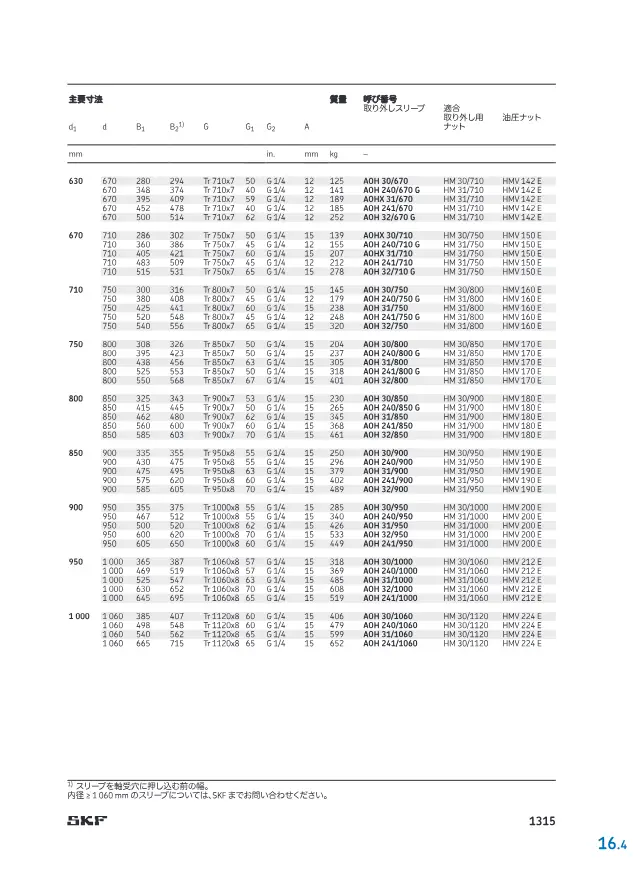
A reduced image of the relevant page is quoted from the document. Copyright belongs to SKF.Request removal
Specifications
| Dimensional Standard | ISO 2982-1 |
|---|---|
| Inner diameter tolerance | JS9 |
| Width Tolerance | h13 |
| Taper ratio of outer diameter | 1:12 (1:30 for A(O)H 240 and 241 series) |
| Thread standard (bore diameter 180 mm or less) | Metric threads per ISO 965-3 |
| Thread standard (bore diameter 190 mm or more) | Metric trapezoidal threads per ISO 2903 |
| Shaft tolerance | h9 |
| Cylindricity | IT5/2(ISO 1101) |
How to choose Removal sleeves
Points to check when selecting, with the values for this product (Withdrawal Sleeve).
-
1. Select inner diameter d1 to match shaft diameter
The inner diameter d1 is the applicable shaft diameter. Listed products range from 35 to 1060 mm. Also confirm that shaft machining can meet the recommended shaft tolerance and cylindricity. Poor roundness or cylindricity causes uneven interference, which can lead to inner ring cracking or creep (slip rotation).
-
2. Match outer diameter d to bearing bore
The outer diameter d is the nominal outer diameter of the tapered section and corresponds to the bore of the bearing to be combined. Even for the same shaft diameter, the outer diameter and width vary by bearing series. Therefore, verify the combination with the bearing to be used against the applicable bearing series and bearing number table when selecting.
-
3. Match taper ratio to the bearing
This product: Taper ratio of outer diameter 1:12 (1:30 for A(O)H 240 and 241 series)The outer taper ratio of the sleeve must match the tapered bore of the bearing inner ring. Generally it is 1:12, and wide series (such as the 240 and 241 series) use 1:30. A mismatched taper ratio will not clamp correctly and internal clearance cannot be adjusted properly. Check against the suffix of the bearing number (K or K30).
-
4. Check width B1 and shaft mounting length
Width B1 is the total width of the sleeve. It equals the bearing width plus the press-in allowance and nut engagement allowance, so confirm it fits within the dimension from the shoulder of the stepped shaft to the shaft end. If it does not fit, the bearing cannot be pushed to its specified position.
-
5. Match thread size and withdrawal nut
During removal, the withdrawal nut is fitted to the thread on the sleeve and used to pull it out. Confirm the thread designation and applicable nut number, and arrange the nut at the same time. Generally, small sizes use metric threads, and large sizes with inner diameter of 190 mm or more use trapezoidal threads.
-
6. Select hydraulic-removal type for large sizes
Large bearings have high clamping force, making mechanical extraction difficult. Selecting the H-type model with oil holes and oil grooves (such as AOH) allows pressure oil to be injected to relieve the interference. Combined with a hydraulic nut, it reduces the maintenance workload.
This guide was written by AI based on the listed products' documents and specification items.
Description
A sleeve with an axial slit; the nut must be ordered separately. Large sizes are provided with anti-rust treatment. The AOH series for oil injection supplies oil from a duct at the threaded end to the oil grooves on the inner and outer diameters.
Features
- Use of a hydraulic nut recommended
- Compatible with the oil injection method (AOH series)
Applications
- Mounting of bearings on the cylindrical seat of a stepped shaft
- Removal of bearings
FAQ
- Q. What are the dimensional standard and tolerances for the AOH series withdrawal sleeve?
- A. The dimensional standard is ISO 2982-1. The bore tolerance is JS9 and the width tolerance is h13. The shaft tolerance is h9, and the cylindricity is IT5/2 (ISO 1101).
- Q. What are the taper ratio and thread standard for the AOH series withdrawal sleeve?
- A. The taper ratio on the outer diameter is 1:12, except for the A(O)H 240 and 241 series, which is 1:30. The thread standard is ISO 965-3 compliant metric thread for bore diameters of 180 mm or less, and ISO 2903 compliant metric trapezoidal thread for bore diameters of 190 mm or more.
- Q. What applications can the AOH series withdrawal sleeve be used for?
- A. It is used by pressing it into the bore of a bearing inner ring when mounting a tapered-bore bearing onto the cylindrical seat of a stepped shaft. It can also be used for removing bearings.
- Q. Can the oil injection method be used with the AOH series withdrawal sleeve?
- A. Yes, the AOH series is compatible with the oil injection method. Oil is supplied from a duct at the threaded end to the oil grooves on the inner and outer diameters. Use of a hydraulic nut is recommended for removal.
- Q. Does the AOH series withdrawal sleeve have a slit structure, and is a nut included?
- A. It is a sleeve with an axial slit. The nut must be ordered separately. Large sizes are provided with anti-rust treatment.
Written by AI based on the content of the source documents.
Source documents
-
Catalog
軸受付属品(アダプタスリーブ・取り外しスリーブ・ロックナット)
74 pages Open page 48
Found on: https://azuma-eg.com/catalogue/
More products from SKF
See all →-
Removal sleeves
Withdrawal Sleeve (AH and AHX Series)
Withdrawal sleeve inserted into the bearing bore to remove the bearing using a hydraulic nut. Shaft diameter range 35 mm to 260 mm.
SKF
-
Removal sleeves
Withdrawal Sleeves (AOH / AOHX)
Sleeve inserted into the bore of a bearing and used together with a hydraulic nut to remove the bearing. Available in many sizes with bore diameters from 460 mm to 1060 mm or more.
SKF
-
Deep Groove Ball Bearings
SKF Explorer 6309
Model: 6309
Deep groove ball bearing with a 45 mm bore and 100 mm outside diameter. With a basic dynamic load rating of 55.3 kN, the calculation example uses it for life evaluation at 3000 r/min.
SKF
-
Self-aligning ball bearings
SKF Explorer Spherical Roller Bearing 24026-2CS2/VT143
Model: 24026-2CS2/VT143
Sealed spherical roller bearing. Used for verification examples of dynamic and static loads in heavy material handling equipment in steel plants.
SKF
-
Deep Groove Ball Bearings
Deep Groove Ball Bearing
A versatile, non-separable ball bearing suitable for high and ultra-high speeds. It accepts both radial and axial loads and requires little maintenance.
SKF
-
Rolling Bearings
SKF Explorer Deep Groove Ball Bearing
A high-performance single-row deep groove ball bearing with reduced friction, noise and vibration, and extended service life. It uses the same designation system as conventional standard bearings and is marked with an asterisk in product tables.
SKF