Guide Rings
SKF (Official website) / Listed on page 45 of the document
Ring products used as guides for sliding parts. Listed in the table of contents of this document, but the body text is not included in the excerpt.
Last verified: (date the content was verified against the source document)
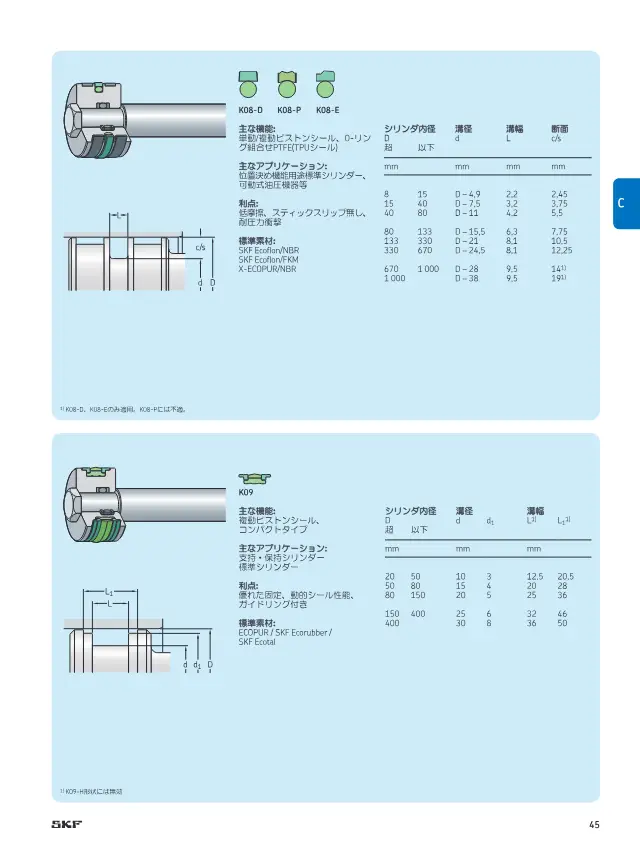
A reduced image of the relevant page is quoted from the document. Copyright belongs to SKF.Request removal
How to choose Guide Rings
Points to check when selecting, with the values for this product (Guide Rings).
-
1. Select Rod Type or Piston Type
Rod-type rings fit into a groove in the inner circumference of the rod cover and guide the rod, while piston-type rings fit into a groove on the piston outer circumference and guide the cylinder bore. Collared, grooved, and L-type shapes may also have separate part numbers for rod and piston use.
-
2. Match Rod Diameter or Bore Diameter
For rod-type rings, the nominal size is the rod outer diameter d; for piston-type rings, it is the cylinder bore diameter D. Listed products include examples covering 6 to 1000 mm. Also confirm the available manufacturing diameter range and whether special diameters can be supplied.
-
3. Select Thickness and Width to Suit the Groove
Cross-sectional thickness is 1.5 to 4 mm for listed products. Determine thickness together with groove depth so that a clearance between metal parts is maintained. Width should match the groove width, and the selection should confirm that the surface pressure under the applied side load remains within the allowable value.
-
4. Check Allowable Surface Pressure Under Side Load
Because guide rings support side loads, keep the surface pressure, calculated as load divided by projected area (diameter × width), below the allowable surface pressure. For high-load applications, consider materials that withstand high surface pressure, such as fabric-reinforced phenolic, or wider cross-sections.
-
5. Match Material to Sliding Speed, Temperature, and Fluid
PTFE-based materials have low friction and suit high-speed use, while fabric-reinforced phenolic offers excellent load-bearing capacity. The maximum sliding speed for listed products is 5 m/s. Verify the operating temperature range and compatibility with media such as hydraulic oil, water, and air for each material.
-
6. Joint Shape and Ease of Installation
The 45° cut is standard, and 90° cut or no-cut options are also available. Split rings are easy to install into the groove, and the joint can absorb dimensional changes from thermal expansion. No-cut rings may not be installable in an integral groove, so select based on the housing structure.
This guide was written by AI based on the listed products' documents and specification items.
Description
The table of contents lists this product group following Rotary Seals. Detailed specifications are not included in the excerpt range and are therefore not provided.
FAQ
- Q. Where are SKF guide rings used?
- A. They are ring products used as guides for sliding parts.
- Q. How are SKF guide rings listed in relation to rotary seals?
- A. The table of contents lists them as a product group following Rotary Seals.
Written by AI based on the content of the source documents.
Source documents
-
Catalog
カスタムエンジニアリングシール シール製品案内
56 pages Open page 45
Found on: https://azuma-eg.com/catalogue/
Similar products (other manufacturers)
Guide Rings products, ordered by similarity of specifications and applications.
-
Backup Rings
Backup Ring (JIS B 2401 P・G)
PTFE backup ring conforming to JIS B 2401 P・G series. Available in spiral, bias-cut, and endless shapes.
JTEKT Corporation
-
O-Rings
O-Ring
O-rings used for sealing water, oil, air, various gases and chemicals. Available in a wide range of sizes and types.
JTEKT Corporation
More products from SKF
See all →-
Guide Rings
Guide Ring (F01 Rod/Piston Guide Ring)
Model: F01
Guide ring for rods and pistons in dynamic applications. Standard cut is 45°, with non-split and 90° cut types also available to order.
SKF
-
Guide Rings
Guide Ring F02
Model: F02
Guide ring for rods and pistons. Can also be used as a flat washer or spacer.
SKF
-
Guide Rings
Guide Ring F03
Model: F03
An L-shaped piston guide ring that combines the functions of a guide ring and a backup ring.
SKF
-
Guide Rings
Guide Ring F04
Model: F04
Guide ring for rods with a shape equivalent to F03.
SKF
-
Guide Rings
Guide Ring F05
Model: F05
Piston guide ring with inner collar. Available in split and non-split types.
SKF
-
Guide Rings
Guide Ring F06
Model: F06
Rod guide ring with outer collar. Available with or without split.
SKF