LFFM 100 Food-Grade Chain Oil (General Purpose)
Model LFFM 100 / LFFM 100 / SKF (Official website) / Listed on page 159 of the document
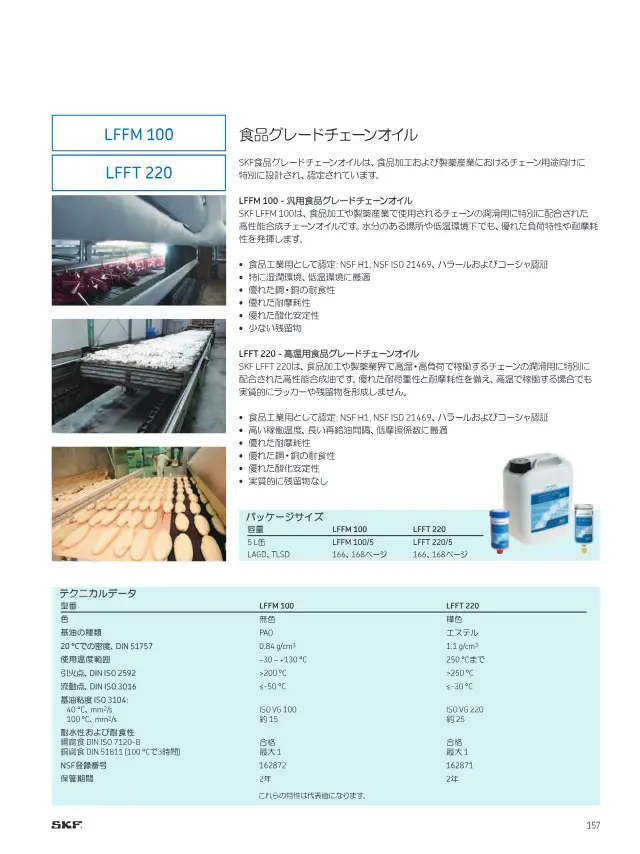
Synthetic food-grade chain oil based on PAO base oil. Suitable for humid and low-temperature environments; NSF H1 registered.
Last verified: (date the content was verified against the source document)
A reduced image of the relevant page is quoted from the document. Copyright belongs to SKF.Request removal
Specifications
| Operating Temperature Range | -30~+130 °C |
|---|---|
| Flash Point | >200 °C |
| Pour Point | ≤-50 °C |
| Kinematic viscosity (40°C) | ISO VG 100 |
| Kinematic viscosity (100°C) | Approx. 15 mm2/s |
| Density (20°C) | 0.84 g/cm3 |
| Storage Period | 2 年 |
How to choose Lubricating oils
Points to check when selecting, with the values for this product (LFFM 100).
-
1. Match the viscosity grade to the machine specification
ISO VG is a viscosity grade classified by the midpoint kinematic viscosity at 40°C, such as VG 68, 100 and 220. If the viscosity is too low, oil film breakdown causes wear; if it is too high, penetration is insufficient and power loss increases. First confirm the grade specified by the machine manufacturer, and choose a higher grade for high loads.
-
2. Also check viscosity at high temperature
This product: Kinematic viscosity (100°C) Approx. 15 mm2/sOil viscosity decreases as temperature rises, so check the kinematic viscosity at 100°C as well as at 40°C. Listed products range from 9 to 25 mm2/s. For applications at high temperature, such as in-oven chains, selecting a product that retains sufficient viscosity at high temperature helps maintain the oil film.
-
3. Confirm the operating temperature range suits the environment
This product: Operating Temperature Range -30~+130 °CProducts are rated for different temperature conditions, such as high-temperature, medium-temperature and low-temperature environments. Check not only the maximum temperature but also the minimum temperature for startup in freezers or cold regions. At high temperatures, evaporation and sludge formation are issues, while at low temperatures, reduced fluidity becomes a problem.
-
4. Select a base oil suited to the application
Mineral oils are general-purpose and easy to handle, PAO offers low-temperature fluidity and oxidation stability, and esters offer low evaporation at high temperature and minimal residue. Listed examples differentiate use as follows: mineral oil for medium temperature, ester-based for high temperature, and PAO-based for low-temperature or humid environments.
-
5. Check the pour point at low temperature
This product: Pour Point ≤-50 °CThe pour point is a guide to the lowest temperature at which oil remains fluid. Listed products range from -50 to -30°C. In freezing and refrigeration equipment or outdoor cold environments, selecting a product with a pour point well below the minimum operating temperature prevents lubrication failure at startup.
-
6. Verify certifications for food and pharmaceutical plants
Production lines in food and pharmaceutical manufacturing may require NSF H1-registered lubricants, which permit incidental food contact. Silicone-free products may also be specified near painting processes. Confirm the certifications and labeling match the plant's hygiene standards and process constraints.
This guide was written by AI based on the listed products' documents and specification items.
Description
Colorless synthetic oil for chain lubrication in food and pharmaceutical plants. Offers excellent wear resistance and oxidation stability, with low residue. Certified NSF H1, Halal, and Kosher.
Features
- NSF H1 registered
- Ideal for humid and low-temperature environments
- Excellent wear resistance
- Excellent oxidation stability
- Low residue
Applications
- Chain lubrication in the food processing and pharmaceutical industries
FAQ
- Q. In what environments can LFFM 100 Food-Grade Chain Oil be used?
- A. It is ideal for humid and low-temperature environments. The operating temperature range is -30 to +130 °C.
- Q. What industries and applications is LFFM 100 suited for?
- A. It is intended for chain lubrication in the food processing and pharmaceutical industries. It is a colorless synthetic oil for chain lubrication in food and pharmaceutical plants.
- Q. What certifications and standards does LFFM 100 have?
- A. It is NSF H1 registered. It is also certified Halal and Kosher.
- Q. What are the viscosity, flash point, and pour point of LFFM 100?
- A. Kinematic viscosity at 40 °C is ISO VG 100, and kinematic viscosity at 100 °C is approximately 15 mm2/s. Flash point is >200 °C, and pour point is ≤-50 °C.
- Q. What are the features and shelf life of LFFM 100?
- A. It offers excellent wear resistance and excellent oxidation stability, with low residue. The shelf life is 2 years.
Written by AI based on the content of the source documents.
Source documents
-
Catalog
SKFメンテナンス製品と潤滑製品
204 pages Open page 159
Found on: https://azuma-eg.com/catalogue/
Similar products (other manufacturers)
Lubricating oils products, ordered by similarity of specifications and applications.
-
Grease
EXSEV-EX (Grease)
Model: SVEX1KG
Fluorinated grease with excellent heat and corrosion resistance and low particle generation, usable even under vacuum.
JTEKT Corporation
-
Grease
EXSEV®-EX (Grease)
Fluorinated grease for vacuum environments with low particle generation. Usable in rolling bearings, linear motion bearings, and ball screws.
JTEKT Corporation
More products from SKF
See all →-
Lubricating oils
LFFT 220 Food-Grade Chain Oil
Model: LFFT 220
Ester-based synthetic food-grade chain oil. For high-temperature, high-load chains, NSF H1 registered.
SKF
-
Lubricating oils
LHMT 68 Medium-Temperature Chain Oil
Model: LHMT 68
Mineral oil-based chain oil for medium temperatures. Offers excellent wear resistance and corrosion resistance, and is silicone-free.
SKF
-
Lubricating oils
LHHT 250 High-Temperature Chain Oil
Model: LHHT 250
Ester-based high-temperature, high-load chain oil. Usable up to 250°C with minimal residue formation.
SKF
-
Deep Groove Ball Bearings
SKF Explorer 6309
Model: 6309
Deep groove ball bearing with a 45 mm bore and 100 mm outside diameter. With a basic dynamic load rating of 55.3 kN, the calculation example uses it for life evaluation at 3000 r/min.
SKF
-
Self-aligning ball bearings
SKF Explorer Spherical Roller Bearing 24026-2CS2/VT143
Model: 24026-2CS2/VT143
Sealed spherical roller bearing. Used for verification examples of dynamic and static loads in heavy material handling equipment in steel plants.
SKF
-
Deep Groove Ball Bearings
Deep Groove Ball Bearing
A versatile, non-separable ball bearing suitable for high and ultra-high speeds. It accepts both radial and axial loads and requires little maintenance.
SKF