LGEM 2 Solid Lubricant-Containing High-Viscosity Bearing Grease
Model LGEM 2 / LGEM / SKF (Official website) / Listed on page 147 of the document
A high-viscosity grease blended with molybdenum disulfide and graphite. Designed for severe construction equipment applications involving high load, high vibration, and low-speed rotation.
Last verified: (date the content was verified against the source document)
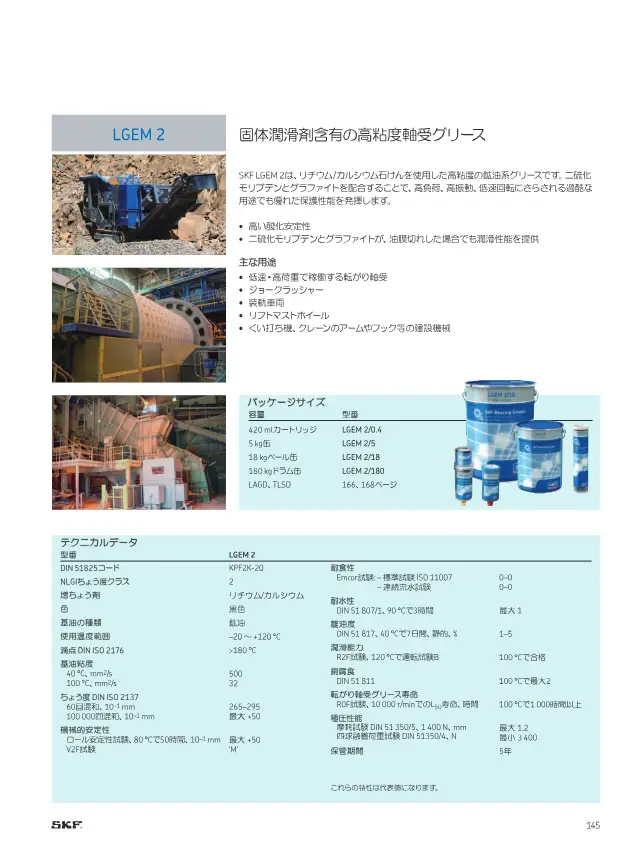
A reduced image of the relevant page is quoted from the document. Copyright belongs to SKF.Request removal
Specifications
| DIN 51825 code | KPF2K-20 |
|---|---|
| NLGI viscosity grade (consistency number) | 2 |
| Thickener | Lithium/calcium |
| Color | Black |
| Base oil type (kind) | Mineral oil |
| Operating Temperature Range | –20 ~ +120 °C |
| Dropping Point | >180 °C |
| Base oil kinematic viscosity (40°C) | 500 mm2/s |
| Base oil kinematic viscosity (100°C) | 32 mm2/s |
| Worked Penetration (60 Strokes Working) | 265–295 10–1 mm |
| Four-ball welding load | Min. 3400 N |
How to choose Grease
Points to check when selecting, with the values for this product (LGEM 2).
-
1. Check the operating temperature range and dropping point
This product: Operating Temperature Range –20 ~ +120 °CFirst confirm that the operating temperature falls within the service temperature range. Listed dropping points range from 120 to 300°C, which indicate the temperature at which the grease softens and flows at high temperature, but the dropping point is not the same as the continuous service temperature. On the low-temperature side, starting torque and pumpability are affected.
-
2. Select base oil viscosity to suit speed and load
This product: Base oil kinematic viscosity (40°C) 500 mm2/sThe base oil kinematic viscosity at 40°C varies widely among listed products, from 18 to 1370 mm2/s. Low viscosity suits high-speed rotation or low-torque applications, while high viscosity suits low-speed, high-load applications where an oil film must be maintained. Estimate the required viscosity from bearing speed, load and operating temperature.
-
3. Evaluate water and heat resistance by thickener
This product: Thickener Lithium/calciumLithium soap is general purpose, lithium complex tends toward higher-temperature use, and calcium sulfonate complex tends to be resistant to large amounts of water and high loads. Greases with different thickeners may soften when mixed, so confirm compatibility with the existing grease when replenishing.
-
4. Match the NLGI consistency grade to the lubrication method
This product: NLGI viscosity grade (consistency number) 2In NLGI grades, a smaller number means a softer grease. Grade 1 is used for pumpability in centralized lubrication, grade 2 for general bearings, and grade 3 for locations where grease tends to flow out, such as vertical shafts and large bearings. Also check the worked penetration range.
-
5. Check extreme pressure performance for high-load applications
This product: Four-ball welding load Min. 3400 NFor shock loads or low-speed, high-load conditions, the four-ball weld load (2000 to 8000 N among listed products) serves as a guide to extreme pressure performance. Where micro-slip or oil film breakdown is likely, grades containing solid lubricants such as molybdenum disulfide or graphite are also candidates.
-
6. Select base oil type for special environments
This product: Base oil type (kind) Mineral oilMineral oil grades are used for general applications, synthetic oils such as PAO for low temperatures down to around -50°C or ultra-high speeds, ester-based biodegradable grades for environmental considerations, and fluorine-based grades for vacuum and clean environments. For vacuum applications, also check the ambient pressure, cleanliness level and evaporation loss data.
This guide was written by AI based on the listed products' documents and specification items.
Description
A high-viscosity mineral oil-based grease with lithium/calcium soap thickener, blended with molybdenum disulfide and graphite. Maintains lubrication performance even when the oil film is depleted.
Features
- High oxidation stability
- Lubrication during oil film depletion provided by molybdenum disulfide and graphite
Applications
- Rolling bearings operating at low speed and high load
- Jaw crushers
- Track-type vehicles
- Lift mast wheels
- Construction equipment such as pile drivers and cranes
FAQ
- Q. What is the operating temperature range and dropping point of LGEM 2?
- A. The operating temperature range is –20 to +120 °C, and the dropping point is >180 °C.
- Q. What applications is LGEM 2 suitable for?
- A. It is suitable for rolling bearings operating at low speed and high load, jaw crushers, track-type vehicles, lift mast wheels, and construction equipment such as pile drivers and cranes. It is designed for severe construction equipment applications involving high load, high vibration, and low-speed rotation.
- Q. What are the lubrication performance features of LGEM 2?
- A. It contains molybdenum disulfide and graphite, which maintain lubrication performance even when the oil film is depleted. High oxidation stability is also a key feature.
- Q. What are the thickener, base oil, and NLGI consistency grade of LGEM 2?
- A. The thickener is lithium/calcium, the base oil is mineral oil, and the NLGI consistency grade (worked penetration number) is 2.
- Q. What are the DIN 51825 code and base oil kinematic viscosity of LGEM 2?
- A. The DIN 51825 code is KPF2K-20. The base oil kinematic viscosity is 500 mm2/s at 40 °C and 32 mm2/s at 100 °C.
Written by AI based on the content of the source documents.
Source documents
-
Catalog
SKFメンテナンス製品と潤滑製品
204 pages Open page 147
Found on: https://azuma-eg.com/catalogue/
Similar products (other manufacturers)
Grease products, ordered by similarity of specifications and applications.
-
Grease
EXSEV-EX (Grease)
Model: SVEX1KG
Fluorinated grease with excellent heat and corrosion resistance and low particle generation, usable even under vacuum.
JTEKT Corporation
-
Grease
EXSEV®-EX (Grease)
Fluorinated grease for vacuum environments with low particle generation. Usable in rolling bearings, linear motion bearings, and ball screws.
JTEKT Corporation
More products from SKF
See all →-
Grease
SKF Bearing Grease (LGMT 2 and General)
A general designation for bearing greases with different applications and temperature ranges depending on thickener type, including lithium, lithium complex, polyurea, and PTFE. Food-grade versions are also included.
SKF
-
Grease
LGMT 2 General Purpose Bearing Grease for Industrial and Automotive Use
Model: LGMT 2
Mineral oil-based general purpose bearing grease thickened with lithium soap. Suitable for a wide range of applications from industrial to automotive use, offering excellent oxidation stability, mechanical stability, and water resistance.
SKF
-
Grease
LGMT 3 General Industrial and Automotive Multi-Purpose Bearing Grease (Stiff Consistency)
Model: LGMT 3
Mineral oil-based grease thickened with lithium soap. Stiff consistency for large bearings, vertical shafts, and high-temperature environments. Offers excellent rust protection and oxidation stability within the recommended temperature range.
SKF
-
Grease
LGEP 2 High Load Extreme Pressure Bearing Grease
Model: LGEP 2
Lithium soap mineral oil grease with extreme pressure additives. Designed for lubrication under vibration and severe loads, with excellent corrosion resistance and extreme pressure performance.
SKF
-
Grease
LGWA 2 High-Load, Extreme-Pressure, Wide-Temperature-Range Bearing Grease
Model: LGWA 2
A lithium complex extreme-pressure grease. Supports a wide temperature range and high loads, with high water resistance and corrosion resistance in applications such as wheel bearings.
SKF
-
Grease
LGGB 2 Biodegradable Bearing Grease
Model: LGGB 2
Synthetic ester oil-based biodegradable grease. Low toxicity, suitable for applications where environmental contamination is a concern, with good low-temperature startability and corrosion resistance.
SKF