SKF Steering Encoder Unit
SKFステアリングエンコーダ・ユニット / SKF (Official website) / Listed on page 16 of the document
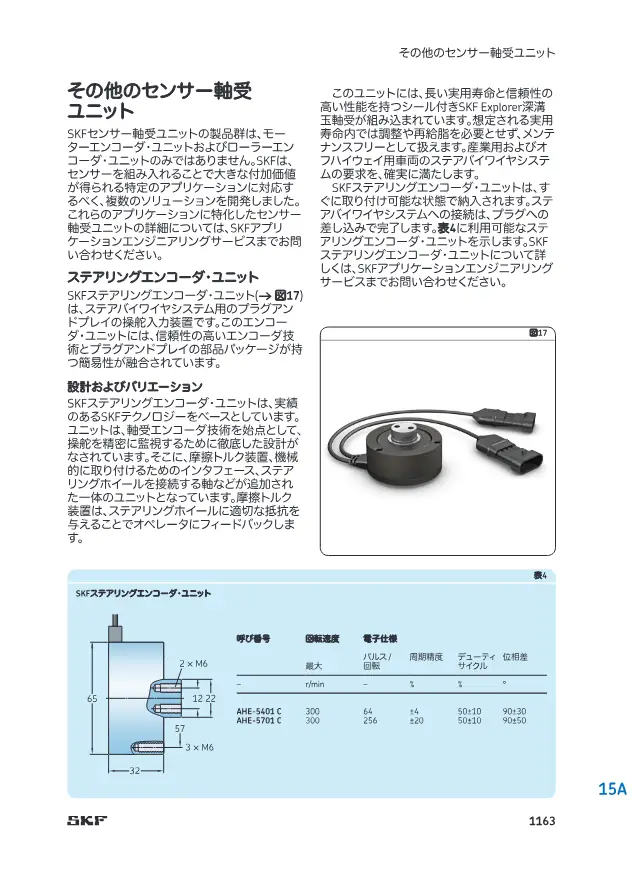
Plug-and-play steering input device for steer-by-wire systems. Detects steering with a non-contact incremental sensor and outputs two redundant signal channels.
Last verified: (date the content was verified against the source document)
A reduced image of the relevant page is quoted from the document. Copyright belongs to SKF.Request removal
Specifications
| Resolution (pulse count) | 64 パルス/回転 |
|---|---|
| Maximum Rotational Speed | 300 r/min |
| Periodic accuracy | ±4 % |
| Duty ratio | 50±10 % |
| Phase Difference | 90±30 ° |
| Power supply voltage | 5~12 V DC |
How to choose Rotary encoders
Points to check when selecting, with the values for this product (SKF Steering Encoder Unit).
-
1. Select pulse count based on required angular resolution
This product: Resolution (pulse count) 64 パルス/回転The number of pulses per revolution determines the smallest detectable angle. Listed products have a relatively low count of 32 to 80 pulses/rev, suited to motor speed control and steering detection. Counting both edges of A and B phases (4x multiplication) quadruples the effective resolution, so confirm the required value together with the processing method of the controller.
-
2. Allow margin in maximum rotational speed
This product: Maximum Rotational Speed 300 r/minThe maximum rotational speed of listed products ranges widely from 300 to 14000 r/min. Confirm that the application's top speed has sufficient margin. Also confirm that the output frequency, determined by rotational speed multiplied by pulse count, falls within the input frequency capability of the receiving-side counter.
-
3. Select a bearing unit with bore matching the shaft diameter
For bearing-integrated types, the bore must match the diameter of the mounting shaft. Listed products have bores of 15 to 45 mm, with sizes divided by shaft diameter. Check the fit tolerance and axial positioning method against the drawings, assuming use as a bearing.
-
4. Check mounting space by outer diameter and mass
Outer diameters range from 35 to 85 mm, and masses from 0.07 to 0.53 kg. Check interference with the motor housing or pulley interior, including the cable exit direction. When mounting on a rotating body, consider the effect of mass on inertia and vibration.
-
5. Match supply voltage to the control circuit
This product: Power supply voltage 5~12 V DCListed products operate on a supply voltage of 5 to 12 V DC. Confirm that it matches the available power supply, and that the output signal voltage level and output circuit type meet the input specifications of the receiving side. For automotive applications, also confirm tolerance to supply voltage fluctuations.
-
6. Verify phase difference, duty ratio, and cycle accuracy
This product: Periodic accuracy ±4 %Large variations in the phase difference between A and B phases (normally 90°), duty ratio, or cycle accuracy can cause direction determination errors and speed detection fluctuations. For high-precision speed control, check in the specifications that these tolerances meet the control requirements.
This guide was written by AI based on the listed products' documents and specification items.
Description
Uses a magnetic sensor that is free from wear and supports the requirements of safety-related control systems conforming to ISO 13849. A friction torque device provides resistance to the steering wheel. Outputs two open-collector square-wave channels and requires a 5 to 12 V DC power supply.
Features
- Wear-free non-contact magnetic sensor
- Redundancy with two independent sensors
- Supports safety-related control conforming to ISO 13849
- Plug-in connection available
Applications
- Industrial vehicles
- Steer-by-wire systems for off-highway vehicles
FAQ
- Q. What types of vehicles can the SKF Steering Encoder Unit be used with for steer-by-wire systems?
- A. It can be used in steer-by-wire systems for industrial vehicles and off-highway vehicles.
- Q. What is the steering detection method of the SKF Steering Encoder Unit and how does it address wear?
- A. It detects steering using a non-contact magnetic sensor, so it is wear-free.
- Q. Which safety-related control standards does the SKF Steering Encoder Unit support?
- A. It supports the requirements of safety-related control systems conforming to ISO 13849. It outputs redundant two-channel signals from two independent sensors.
- Q. What are the resolution, maximum rotational speed, and supply voltage of the SKF Steering Encoder Unit?
- A. The resolution is 64 pulses/revolution, the maximum rotational speed is 300 r/min, and the supply voltage is 5 to 12 V DC.
- Q. What is the output method and signal specification of the SKF Steering Encoder Unit?
- A. It outputs two open-collector square-wave channels. The duty ratio is 50±10 %, the phase difference is 90±30 °, and the period accuracy is ±4 %.
Written by AI based on the content of the source documents.
Source documents
-
Catalog
SKF 転がり軸受カタログ 15 エンジニアリング製品 15A センサー軸受ユニット
120 pages Open page 16
Found on: https://azuma-eg.com/catalogue/
More products from SKF
See all →-
Rotary encoders
SKF Roller Encoder Unit
Model: AHE-5509 A
A plug-and-play bearing unit with an integrated encoder for applications where the outer ring rotates. Can be incorporated into pulleys, rollers and similar components.
SKF
-
Rotary encoders
Motor Encoder Unit (BMB/BMO Series)
Motor encoder unit integrated with a bearing. Multiple sizes with bore diameters of 15 to 45 mm are available, and model numbers differ by pulse count and output cable length.
SKF
-
Deep Groove Ball Bearings
SKF Explorer 6309
Model: 6309
Deep groove ball bearing with a 45 mm bore and 100 mm outside diameter. With a basic dynamic load rating of 55.3 kN, the calculation example uses it for life evaluation at 3000 r/min.
SKF
-
Self-aligning ball bearings
SKF Explorer Spherical Roller Bearing 24026-2CS2/VT143
Model: 24026-2CS2/VT143
Sealed spherical roller bearing. Used for verification examples of dynamic and static loads in heavy material handling equipment in steel plants.
SKF
-
Deep Groove Ball Bearings
Deep Groove Ball Bearing
A versatile, non-separable ball bearing suitable for high and ultra-high speeds. It accepts both radial and axial loads and requires little maintenance.
SKF
-
Rolling Bearings
SKF Explorer Deep Groove Ball Bearing
A high-performance single-row deep groove ball bearing with reduced friction, noise and vibration, and extended service life. It uses the same designation system as conventional standard bearings and is marked with an asterisk in product tables.
SKF