Small-Diameter Parallel Pin
小径平行ピン / Spring net (Official website) / Listed on page 27 of the document
Small-diameter parallel pin made of stainless steel with hardness of HV450 or higher. Sold in outer diameters ranging from 1 to 3 mm.
Last verified: (date the content was verified against the source document)
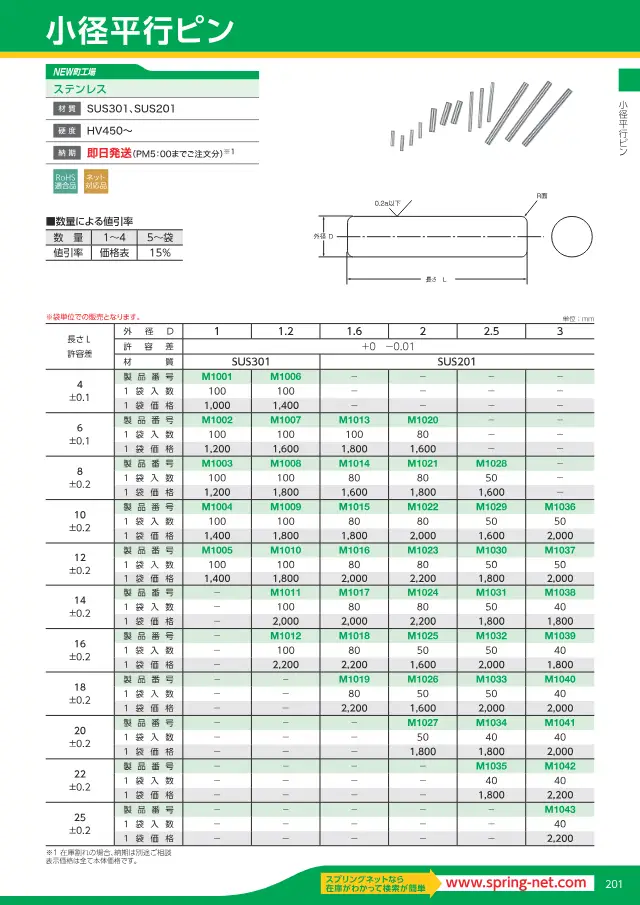
A reduced image of the relevant page is quoted from the document. Copyright belongs to Spring net.Request removal
Specifications
| Material | SUS301, SUS201 |
|---|---|
| Hardness | HV450 or higher |
| Outer diameter | 1~3 mm |
How to choose Pins & Shafts
Points to check when selecting, with the values for this product (Small-Diameter Parallel Pin).
-
1. Select the outer diameter to match the mating hole
The outer diameter is selected to suit the hole diameter of the mating part or the bore of a bearing. Listed products range from extra-fine 0.1 mm diameters to about 10 mm. Fine diameters bend easily, so the balance with load and length should also be checked. Compare the nominal diameter and the actual permissible range together with the diameter tolerance.
-
2. Choose a diameter tolerance suited to the fit
Tolerance symbols such as h7, g6 and m6 determine the range within which the outer diameter falls relative to the basic dimension. For press-fit fixing, choose a tighter interference fit such as m6; for sliding or rotation, choose a clearance fit such as g6 or h7. Combine these with the tolerance of the mating hole.
-
3. Determine the required overall length and whether long lengths are available
Overall length is determined from the hole depth of the mounting area and the support span. Listed products range from 2 mm to 150 mm, and long lengths may be offered as a separate series. The longer the part, the more deflection and straightness effects tend to appear, so consider a larger diameter or additional support points.
-
4. Select a material suited to the operating environment
This product: Material SUS301, SUS201Stainless steels such as SUS304 and SUS303 resist rust and suit humid or washed environments. SUS303 is a steel grade with improved machinability. Where wear or high load is a concern, select hardenable steels or products with higher hardness.
-
5. Check hardness and surface treatment of sliding areas
Where the shaft rubs against a bearing or seal, surface hardness affects wear life. Some products have surfaces hardened by hard chrome plating or quenching, and repair sleeves for oil seal areas are available with hard chrome plating for high hardness. Also confirm whether the plating thickness is included in the stated dimensions.
-
6. Check whether the end shape allows easy insertion
Chamfered or rounded ends make insertion into holes easier and help prevent damage to the mating bore. Parallel pins may be classified by end shape, such as Type A and Type B, so select according to the assembly method and whether press-fitting is required.
This guide was written by AI based on the listed products' documents and specification items.
Description
Small-diameter parallel pin made of SUS301 and SUS201. Available in many model numbers based on combinations of outer diameter and length, sold by the bag.
Features
- Hardness of HV450 or higher
- 15% discount for quantity purchases
Applications
- Positioning
- Fixing mechanical components
FAQ
- Q. What are the material and hardness of the small-diameter parallel pin?
- A. The material is SUS301 and SUS201. The hardness is HV450 or higher.
- Q. How should I select the outer diameter and length of the small-diameter parallel pin?
- A. Outer diameters are available in the range of 1 to 3 mm. There are many model numbers based on combinations of outer diameter and length.
- Q. In what unit is the small-diameter parallel pin sold?
- A. It is sold by the bag.
- Q. What applications can the small-diameter parallel pin be used for?
- A. It can be used for positioning and fixing mechanical components.
Written by AI based on the content of the source documents.
Source documents
-
Catalog
スプリングネット 製品カタログ(ページ抜粋)
43 pages Open page 27
Found on: https://www.samini.co.jp/catalog_list/
More products from Spring net
See all →-
Springs
Daruma Pin
Daruma pin made of stainless spring steel wire. Compatible with shaft diameters of 4 to 20 mm, with same-day shipping.
Spring net
-
Springs
Clip Ring
Stainless steel wire retaining ring for shaft diameters of 4 to 16 mm, with same-day shipping available.
Spring net
-
Springs
Bending Process Free Size
Stainless steel wire bent to specified length and angle. Wire diameter 0.5 to 3.5 mm.
Spring net
-
Springs
Ring
Ring made of stainless steel spring wire. Wire diameter 0.6 to 1.6 mm, sold by bag.
Spring net
-
Springs
Anti-Loosening Spring
Stainless steel torsion spring that prevents bolt loosening. Compatible with M5 to M16.
Spring net
-
Springs
Spring Antenna
Stainless steel spring antenna with close-contact coil and straight section. For M3 to M10.
Spring net