Bearing Unit for Tension Leveler
JTEKT Corporation (Official website) / Listed on page 10 of the document
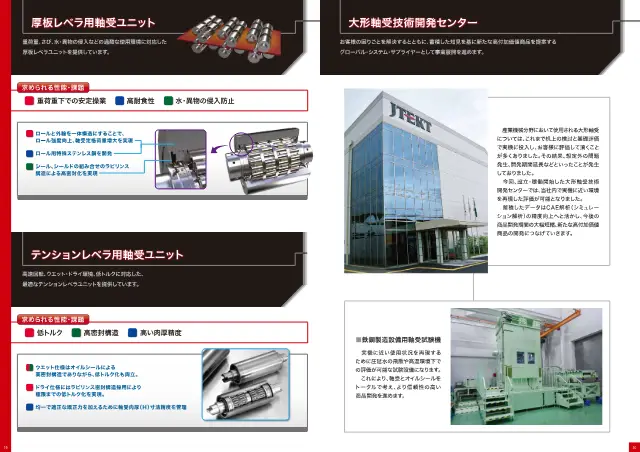
Bearing unit for tension levelers supporting high-speed rotation, wet and dry environments, and low torque.
Last verified: (date the content was verified against the source document)
A reduced image of the relevant page is quoted from the document. Copyright belongs to JTEKT Corporation.Request removal
How to choose Bearing units
Points to check when selecting, with the values for this product (Bearing Unit for Tension Leveler).
-
1. Match shaft diameter and dimensional system (metric/inch)
Bearing units are offered in separate metric and inch series, and they are not interchangeable even when their appearance is similar. Listed products cover metric sizes of 3 to 150 mm and inch sizes of 1 to 4 in. First determine the shaft diameter and dimensional system, then select from the corresponding series.
-
2. Check the rated load against the operating conditions
The basic dynamic load rating Cr is used for rolling fatigue life calculations, and the basic static load rating C0r is used for evaluating stationary or shock loads. Listed Cr values range from 7.28 to 793 kN, and there are heavy-load products, such as half-ring types, with increased static load ratings.
-
3. Select a specification suited to the operating temperature
Standard greases and rubber seals deteriorate at high temperatures. High-temperature specifications are available in types with different upper temperature limits; for example, VA201 is rated at 130 to 250°C and VA228 at 260 to 350°C. In addition to the ambient temperature, check the permissible seal temperature and the sealed grease.
-
4. Choose the shaft fixing method for the application
Set-screw type is easy to install but requires control of the tightening torque. The method that fixes the bearing with a tapered bore and adapter sleeve provides a secure connection to the shaft and suits applications with reversing rotation or vibration. Check it together with the recommended shaft tolerance grade.
-
5. Verify the permissible rotational speed
Bearing units have an upper limit on usable rotational speed depending on seal friction and the fixing method. The permissible speeds of listed products range widely from 6 to 12000 r/min, and low-speed heavy-load and high-speed units have very different characteristics. Confirm that the operating speed has sufficient margin.
-
6. Allow for shaft tilt during installation
In the spherical-fit design, the unit can absorb shaft tilt during installation up to a certain angle. However, in structures that allow regreasing, the permissible angle may be smaller. Listed products include an example of 2°. Check the permissible misalignment according to the accuracy of the base or frame.
This guide was written by AI based on the listed products' documents and specification items.
Description
The wet specification achieves high sealing performance with an oil seal structure, while the dry specification reduces torque with a labyrinth seal structure.
Features
- Oil seal sealing for wet specification
- Low torque achieved by labyrinth sealing for dry specification
- High-precision control of bearing wall thickness dimensions
Applications
- Tension leveler
FAQ
- Q. Can the bearing unit for tension levelers be used in both wet and dry environments?
- A. It is a bearing unit for tension levelers supporting high-speed rotation, wet and dry environments, and low torque. The wet specification adopts a high-sealing structure with an oil seal, and the dry specification adopts a labyrinth seal structure.
- Q. How does the sealing structure differ between the wet and dry specifications of the bearing unit for tension levelers?
- A. The wet specification has a high-sealing structure using an oil seal. The dry specification uses a labyrinth seal structure, which achieves low torque.
- Q. How is the bearing wall thickness dimension of the bearing unit for tension levelers controlled?
- A. The bearing wall thickness dimension is controlled with high precision.
Written by AI based on the content of the source documents.
Source documents
- Catalog 製鉄・圧延設備用 高性能商品シリーズ Open page 10
Similar products (other manufacturers)
Bearing units products, ordered by similarity of specifications and applications.
-
Bearing units
ICOS Oil Seal Bearing Unit
Oil seal bearing unit with bore diameter of 12 to 30 mm. Dimensions, basic load ratings and limiting speeds are listed for each model number.
SKF
-
Bearing units
High-Temperature Ball Bearing Unit (Cast Pillow Block Housing)
Bearing unit combining a cast pillow block housing with high-temperature insert bearing. Available in metric and inch series with bore diameters of 20 to 60 mm.
SKF
-
Cylindrical Roller Bearings
RCC Bearing (Sealed Cylindrical Roller Bearing for Railway Vehicle Axle Boxes)
A sealed double-row cylindrical roller bearing unit for railway vehicle axle boxes. Seals at both ends and long-life grease enhance maintainability and reliability.
NSK
-
Needle roller bearings
Needle Roller Bearing with Cage
Needle roller bearing with a cage that guides the rollers. Small diameter with high load capacity, low friction, suitable for high-speed rotation. Also suitable for oscillating applications.
NTN Corporation
-
Needle roller bearings
Full Complement Drawn Cup Needle Roller Bearing
A needle roller bearing without a cage, with a large number of rollers to achieve high load capacity. Suitable for high-load, low-speed, and oscillating applications.
NTN Corporation
More products from JTEKT Corporation
See all →-
Bearing units
Half-Ring Type Bearing Housing Unit for Continuous Casting Machines
A half-ring type bearing housing unit used for intermediate support of pinch rolls in continuous casting machines. Bore diameter class of 100 to 150 mm, with a cooling structure that rectifies water flow.
JTEKT Corporation
-
Bearing units
Support Bearing Unit for Precision Ball Screws BSU1747BDF
Model: BSU1747BDF
Bearing unit for precision ball screw support incorporating SAC1747BDF. Housing outer diameter 60 mm, excellent dust resistance.
JTEKT Corporation
-
Bearing units
Half-Ring Type Split Bearing Unit (HSC Bearing)
Half-ring type split bearing unit. Compact sealed structure and high cooling efficiency; heavy-load product.
JTEKT Corporation
-
Bearing units
Bearing Unit for Plate Levelers
A bearing unit for plate levelers designed for harsh environments involving heavy loads, rust, and water or foreign matter ingress.
JTEKT Corporation
-
Deep Groove Ball Bearings
Deep Groove Ball Bearing
Single-row ball bearing that accepts radial load and axial load in both directions. Suitable for high-speed rotation and low-vibration applications. Dimension tables cover bore diameters from 100 to 1420 mm.
JTEKT Corporation
-
Angular Contact Ball Bearings
Angular Contact Ball Bearing
Angular contact ball bearings that accept axial loads in one or both directions depending on contact angle. Available as single row and back-to-back or face-to-face combinations (DB, DF), with bore diameters of approximately 100 to 300 mm.
JTEKT Corporation