Single-Direction Thrust Ball Bearing
単式スラスト玉軸受 / JTEKT Corporation (Official website) / Listed on page 206 of the document
A ball bearing that receives axial load in one direction, with sizes of d 100 to 530 mm listed. Not suitable for high-speed rotation.
Last verified: (date the content was verified against the source document)
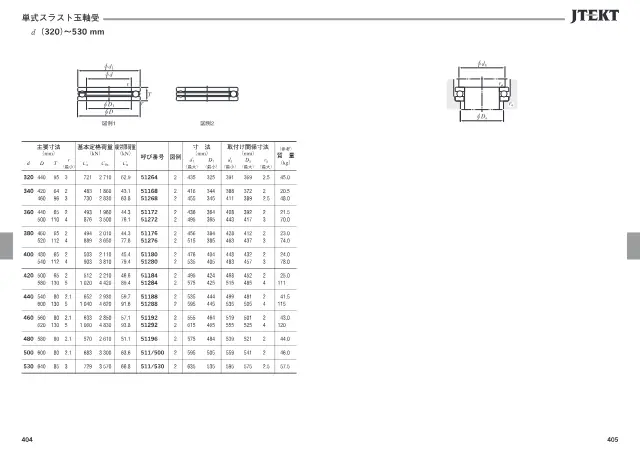
A reduced image of the relevant page is quoted from the document. Copyright belongs to JTEKT Corporation.Request removal
Specifications
| Inner diameter d | 100~530 mm |
|---|---|
| Contact Angle α | 90 度 |
How to choose Rolling Bearings
Points to check when selecting, with the values for this product (Single-Direction Thrust Ball Bearing).
-
1. Bore and housing bore dimensions
This product: Inner diameter d 100~530 mmSelect the bore diameter d to match the shaft seat, the outside diameter D to match the housing bore, and the width B to suit the installation space. Main dimensions are standardized in ISO and JIS dimension series, so interchangeable products can be found by boundary dimension designation. For tapered roller bearings, also check the assembled width T; for thrust bearings, also check the height H.
-
2. Dynamic load rating based on life calculation
The basic dynamic load rating Cr is the reference value for calculating rated life. Verify that the required life is met using the equivalent load during operation and the rotational speed. For ball bearings, life is proportional to the cube of the load ratio, so providing load margin greatly extends life.
-
3. Margin for static and shock loads
The basic static load rating C0r is the allowable standard for permanent deformation generated at the rolling elements and raceways under stationary or low-speed conditions. For applications with oscillating motion or shock loads, confirm that a static safety factor against the maximum load is secured using C0r.
-
4. Operating speed and lubrication method
The limiting speed differs by lubrication method, and separate values are given for grease lubrication and oil lubrication. Confirm that the normal operating speed does not exceed the limiting value, and in high-speed ranges also consider cage material and precision grade. The reference speed can also be consulted as a thermal guideline.
-
5. Precision grade and internal clearance
Precision grades (P0, P6, P5, etc.) indicate rotational accuracy and dimensional accuracy; for high-precision applications such as machine tool spindles, select higher grades. Internal clearance (C2, CN, C3, etc.) is selected to allow for changes caused by interference fit and temperature differences during operation.
-
6. Materials and lubrication suited to the environment
For corrosive, high-temperature, vacuum, or clean environments, select specifications such as rings and rolling elements made of stainless steel or ceramics, or solid lubricants and fluorine grease for vacuum use. Check the operating temperature range, low dust generation, and whether food-grade grease registration applies against the application conditions.
This guide was written by AI based on the listed products' documents and specification items.
Description
The contact angle is 90 degrees, and inclination is not permissible. During high-speed rotation, a minimum required axial load must be applied to prevent slippage. Standard cages are pressed steel cages or machined cages.
Features
- Supports axial load in one direction
- Large axial load capacity
- Not suitable for high-speed rotation
FAQ
- Q. What type of load can a single-direction thrust ball bearing receive?
- A. It is a ball bearing that receives axial load in one direction. It features a large axial load capacity.
- Q. What is the bore diameter and size range of a single-direction thrust ball bearing?
- A. Sizes with a bore diameter d of 100 to 530 mm are listed.
- Q. Can a single-direction thrust ball bearing be used for high-speed rotation?
- A. It is not suitable for high-speed rotation. During high-speed rotation, a minimum required axial load must be applied to prevent slippage.
- Q. Can a single-direction thrust ball bearing accommodate inclination?
- A. The contact angle is 90 degrees, and inclination is not permissible.
- Q. What are the types of standard cages for a single-direction thrust ball bearing?
- A. Standard cages are pressed steel cages or machined cages.
Written by AI based on the content of the source documents.
Source documents
Similar products (other manufacturers)
Rolling Bearings products, ordered by similarity of specifications and applications.
-
Rolling Bearings
Self-Aligning Ball Bearings and Adapter Sleeves
Combination table of self-aligning ball bearings and adapter sleeves with bore diameters of 17 to 115 mm. Used for mounting on shafts.
SKF
-
Rolling Bearings
Matched Pair Angular Contact Ball Bearings (Bore 55-80 mm)
Matched pair angular contact bearings with bore diameters of 55-80 mm. Dimension table listing dimensions and load ratings.
SKF
-
Rolling Bearings
Bearee™ Resin Rolling Bearing (FL3307 Bearing)
A rolling bearing with inner and outer rings and cage made of resin materials offering corrosion resistance and self-lubricating properties. Suitable for environments where steel bearings cannot be used, such as underwater or in chemical solutions.
NTN Corporation
-
Rolling Bearings
Non-Separable Race-Integrated Thrust Needle Roller Bearing
A non-separable thrust needle roller bearing in which the cage is retained by the ribs of a steel plate race.
NTN Corporation
-
Rolling Bearings
Bearing for Gyroscopes
Small-diameter precision ball bearings used for the rotor shaft and gimbal shaft of gyroscopes. Features low starting torque and stable rotation, with cage and grease design minimizing torque variation.
NSK
-
Springs
Super Spring Kit
A kit containing springs from the K, D, and DS series. A selection set for prototype design and jig and fixture maintenance.
KS Industries Co., Ltd.
More products from JTEKT Corporation
See all →-
Rolling Bearings
Double-Row Cylindrical Roller Bearings (NN Type and NNU Type)
Large double-row cylindrical roller bearings with bore diameters of 670 to 710 mm. Available with cylindrical bore and tapered bore, supporting large radial loads.
JTEKT Corporation
-
Rolling Bearings
Four-Row Cylindrical Roller Bearing
Large four-row cylindrical roller bearings with bore diameters in the 100 to 850 mm range. Multi-row construction provides high load capacity.
JTEKT Corporation
-
Rolling Bearings
Four-Row Cylindrical Roller Bearing (Tapered Bore)
Tapered bore four-row cylindrical roller bearing. A large bearing that uses a tapered sleeve for mounting.
JTEKT Corporation
-
Rolling Bearings
Single-Row Tapered Roller Bearings
Dimension table for large single-row tapered roller bearings with bore diameters from 139.700 mm or more and outside diameters up to 1092.200 mm. Lists principal dimensions, basic dynamic load ratings, fatigue load limits, mounting dimensions, and axial factors.
JTEKT Corporation
-
Rolling Bearings
Four-Row Tapered Roller Bearing, 45D Series
45D series of four-row tapered roller bearings with bore diameters from approximately 346 mm to 510 mm.
JTEKT Corporation
-
Rolling Bearings
Self-Aligning Roller Bearings
Self-aligning roller bearings with bore diameters of 100 to 260 mm. Available with cylindrical and tapered bores for heavy-load and shock-load applications.
JTEKT Corporation