D Series Compression Coil Spring
Dシリーズ / KS Industries Co., Ltd. (Official website) / Listed on page 15 of the document
Compression coil spring manufactured in accordance with the German standard DIN 2098. Available in wire diameters from 0.1 to 10.0 mm, with stainless steel, piano wire, and oil-tempered wire material options.
Last verified: (date the content was verified against the source document)
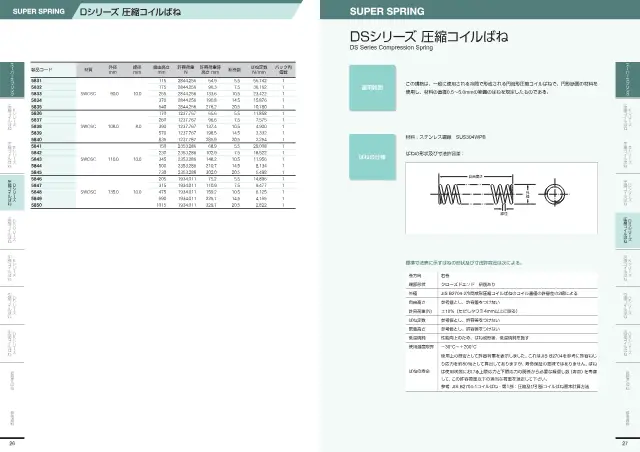
A reduced image of the relevant page is quoted from the document. Copyright belongs to KS Industries Co., Ltd..Request removal
Specifications
| Wire diameter d | 0.1~10.0 mm |
|---|---|
| Operating Temperature Range | −30 to +200 (SUS304), −30 to +80 (SWP) °C |
Dシリーズ model comparison
Compare 2 models in the same series by specification.
| Model | Wire diameter d | Operating Temperature Range |
|---|---|---|
| Dシリーズ 圧縮コイルばね This product | 0.1~10.0 mm | −30 to +200 (SUS304), −30 to +80 (SWP) °C |
| Dシリーズ 引張コイルばね | 0.1–2.5 mm | −30 to +200 °C |
How to choose Compression Coil Springs
Points to check when selecting, with the values for this product (D Series Compression Coil Spring).
-
1. Select by required load and spring rate
The spring rate is the load required to deflect the spring by 1 mm. Multiplying the difference between installed and operating length by the spring rate gives the estimated load generated. Check whether the target load can be achieved within that deflection range, and narrow down candidates by spring rate value.
-
2. Outside or inside diameter to fit the bore or shaft
Check the outside diameter when the spring fits into a bore, and the inside diameter when it fits over a shaft. Because the coil diameter slightly increases under compression, allow clearance to the bore or shaft. The outside diameters of the listed products range from 3 to 11 mm.
-
3. Match free length to installation space
Free length is the length under no load. The difference from the installed length is the initial deflection, which determines the preload force. Slender springs are prone to buckling (bending sideways), so also consider whether a guide rod or guide bore is needed.
-
4. Do not exceed maximum allowable deflection and load
Confirm that the maximum operating stroke stays within the maximum allowable deflection and does not reach solid height. Using the spring beyond the allowable value can cause set (permanent deformation) or fatigue failure. Allow a margin in applications with repeated operation.
-
5. Choose material to suit the environment
SUS304WPB offers corrosion resistance and, in the listed examples, can be used at -30 to +200 °C. Piano wire and oil-tempered wire suit applications that benefit from high strength, but they rust easily, so check whether surface treatment or rust prevention is required.
-
6. End shape that affects seating
Springs with ground ends have flat seating surfaces, so the load acts straight along the axis and the spring is less likely to tilt. For applications such as dies and jigs that require stable posture, check whether grinding is specified.
This guide was written by AI based on the listed products' documents and specification items.
Description
Cylindrical compression coil spring conforming to DIN 2098. Stainless steel wire is used for wire diameters of 0.1 to 0.4 mm, and piano wire or oil-tempered wire is used for 0.5 to 10.0 mm. The operating temperature range varies depending on the material.
Features
- Conforms to DIN 2098
- Wire diameter 0.1 to 10.0 mm
- Material selected according to wire diameter
Applications
- Industrial machinery
- Precision equipment
FAQ
- Q. Which material is used for each wire diameter of the D Series Compression Coil Spring (no model number)?
- A. Stainless steel wire is used for wire diameters of 0.1 to 0.4 mm, and piano wire or oil-tempered wire is used for 0.5 to 10.0 mm. Wire diameters from 0.1 to 10.0 mm are supported.
- Q. How does the operating temperature range of the D Series Compression Coil Spring differ by material?
- A. The operating temperature range is -30 to +200°C (SUS304) and -30 to +80°C (SWP).
- Q. Which standard does the D Series Compression Coil Spring comply with?
- A. It is a compression coil spring manufactured in accordance with the German standard DIN 2098, and is a cylindrical compression coil spring conforming to DIN 2098.
- Q. For which applications in industrial machinery and precision equipment is the D Series Compression Coil Spring suited?
- A. It is intended for applications in industrial machinery and precision equipment.
Written by AI based on the content of the source documents.
Source documents
- Catalog SUPER SPRING 総合カタログ 40 pages Open page 15
More products from KS Industries Co., Ltd.
See all →-
Compression Coil Springs
K Series Compression Coil Spring
General-purpose cold-formed compression coil spring conforming to JIS standards. Made of SUS304WPB stainless steel wire with wire diameters of 0.2 to 3.2 mm; numerous dimensions available under product codes 1001 to 2341.
KS Industries Co., Ltd.
-
Compression Coil Springs
S Series Compression Coil Springs
Piano wire and oil-tempered wire compression coil springs with wire diameters of 1.0 to 9.0 mm, for industrial machinery, dies, jigs and fixtures.
KS Industries Co., Ltd.
-
Compression Coil Springs
DS Series Compression Coil Spring
Compression coil spring based on the piano wire standard dimensions of the D Series, with the material changed to stainless spring steel wire. Wire diameter 0.5 to 5.0 mm.
KS Industries Co., Ltd.
-
Extension Coil Springs
K Series Extension Coil Spring
Extension coil spring made of SUS304WPB stainless steel wire. Covers a wide range of sizes with outer diameters of approximately 2.0 to 20 mm.
KS Industries Co., Ltd.
-
Extension Coil Springs
D Series Extension Coil Spring
Cold-formed extension coil springs with wire diameters of 0.1 to 2.5 mm, available in SUS304WPB and SWP-B piano wire.
KS Industries Co., Ltd.
-
Extension Coil Springs
DS Series Extension Coil Spring
Extension coil springs made of SUS304WPB with wire diameters of 0.5 to 2.5 mm. Model numbers for SWP material are also included.
KS Industries Co., Ltd.