Rod Seal
SKF (Official website) / Listed on page 18 of the document
A range of seal products used at the rod section of hydraulic and pneumatic cylinders. Listed in the table of contents of this document, but the body text is not included in the excerpt.
Last verified: (date the content was verified against the source document)
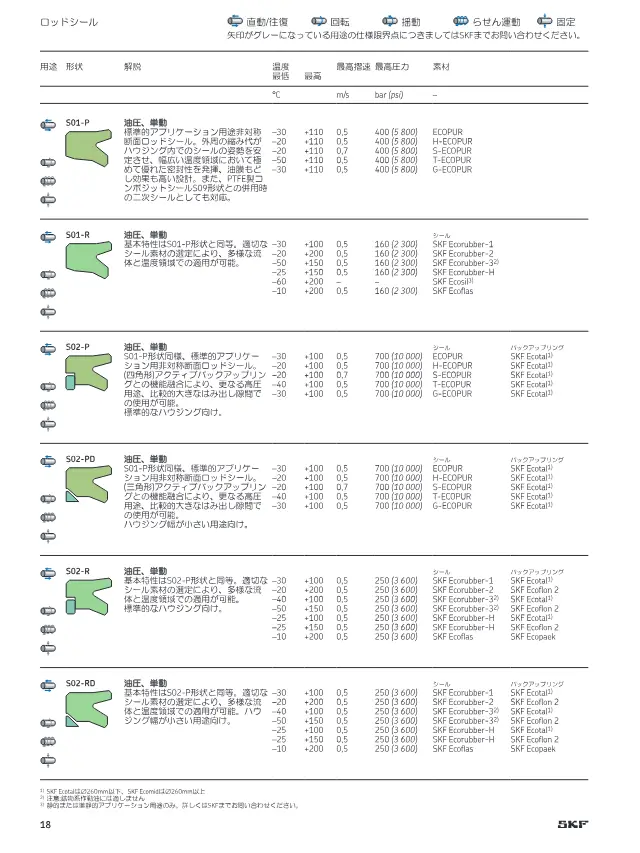
A reduced image of the relevant page is quoted from the document. Copyright belongs to SKF.Request removal
How to choose Rod Seals
Points to check when selecting, with the values for this product (Rod Seal).
-
1. Match rod diameter and groove dimensions
A seal is specified by the combination of applicable rod diameter and installation groove dimensions. The applicable rod diameter of listed products is 5 to 1000 mm. When fitting into an existing groove, check on the drawing that, in addition to the rod diameter, the groove width and groove bottom diameter match the standard combination.
-
2. Verify cross-section and groove width
Cross-section dimension (c/s, radial thickness) corresponds to the groove depth, and groove width L corresponds to the axial length. The listed range is 2.45 to 20 mm cross-section and 2.2 to 50 mm groove width. If dimensions do not match, insufficient squeeze causes leakage, and excessive compression causes early wear.
-
3. Maximum operating pressure and backup rings
The maximum operating pressure of listed products is 160 to 700 bar. At high pressure, the seal tends to extrude into the clearance and fail, so consider types with square or trapezoidal backup rings. Confirm that the pressure, including pressure surges (momentary pressure rises), stays within the upper limit.
-
4. Select material by temperature and fluid compatibility
PU offers excellent wear resistance, while PTFE has high chemical and heat resistance and low friction. Rubber-based materials vary in oil and heat resistance depending on their compound. Operating temperature ranges differ by material, so select a material that suits the working fluid, such as hydraulic oil, water, or air, and the operating temperature.
-
5. Check the upper limit of sliding speed
The maximum sliding speed of listed products is 0.5 to 10 m/s, which varies greatly by material and type. Use at high speed accelerates deterioration due to frictional heat. Check that the maximum cylinder speed is within the upper limit, and consider low-friction PTFE-based types for high-speed applications.
-
6. Select seal type and operating method
Rod seals are basically single-acting types that receive pressure from one side. In high-pressure systems, there is a method of combining them with buffer seals. For large machines that are hard to install or have worn rods, chevron packings, which can be selected as split types, are suitable.
This guide was written by AI based on the listed products' documents and specification items.
Description
The document's table of contents lists it as a product group following Piston Seal. Detailed specifications are not included in the excerpt range and are therefore not described.
Applications
- Hydraulic cylinders
- Pneumatic cylinders
Source documents
-
Catalog
カスタムエンジニアリングシール シール製品案内
56 pages Open page 18
Found on: https://azuma-eg.com/catalogue/
Similar products (other manufacturers)
Rod Seals products, ordered by similarity of specifications and applications.
-
Backup Rings
Backup Ring (JIS B 2401 P・G)
PTFE backup ring conforming to JIS B 2401 P・G series. Available in spiral, bias-cut, and endless shapes.
JTEKT Corporation
-
O-Rings
O-Ring
O-rings used for sealing water, oil, air, various gases and chemicals. Available in a wide range of sizes and types.
JTEKT Corporation
More products from SKF
See all →-
Rod Seals
Rod Seal (S01 Single-Acting Piston Seal, Lip Type (U-Cup) Seal, Compact Seal)
Model: S01
Single-acting piston and rod seal for small and standard hydraulic equipment. Offers high stability within the housing, excellent sealing performance and good back-pumping performance.
SKF
-
Rod Seals
Rod Seal (S09 Single-Acting/Double-Acting Piston Seal, O-Ring Combination PTFE)
Model: S09-E / S09-P / S09-D
Single-acting and double-acting piston seal for civil engineering machinery and high-load hydraulic equipment. Combines an O-ring with PTFE (TPU seal), featuring pressure and impact resistance and long service life.
SKF
-
Rod Seals
Rod Seal (S10/S13 Chevron Packing)
Model: S1012 / S1315
Single-acting rod seal for heavy industrial hydraulic equipment and presses. Suitable for worn rods, with split-type available.
SKF
-
Rod Seals
S01-P Rod Seal
Model: S01-P
A single-acting rod seal that combines high sealing performance and oil film retention across a wide temperature range.
SKF
-
Rod Seals
S01-R Rod Seal
Model: S01-R
Rod seal for SKF Ecorubber-based materials, offering excellent chemical resistance and heat resistance.
SKF
-
Rod Seals
S02-P Rod Seal
Model: S02-P
High-pressure hydraulic rod seal with a square active backup ring.
SKF