Vibration-Damping Damper Spring
防振ダンパーばね(SWP-A・粘弾性体) / Spring net (Official website) / Listed on page 68 of the document
A vibration-isolating spring combining a bone spring with a viscoelastic body to absorb vibration and shock.
Last verified: (date the content was verified against the source document)
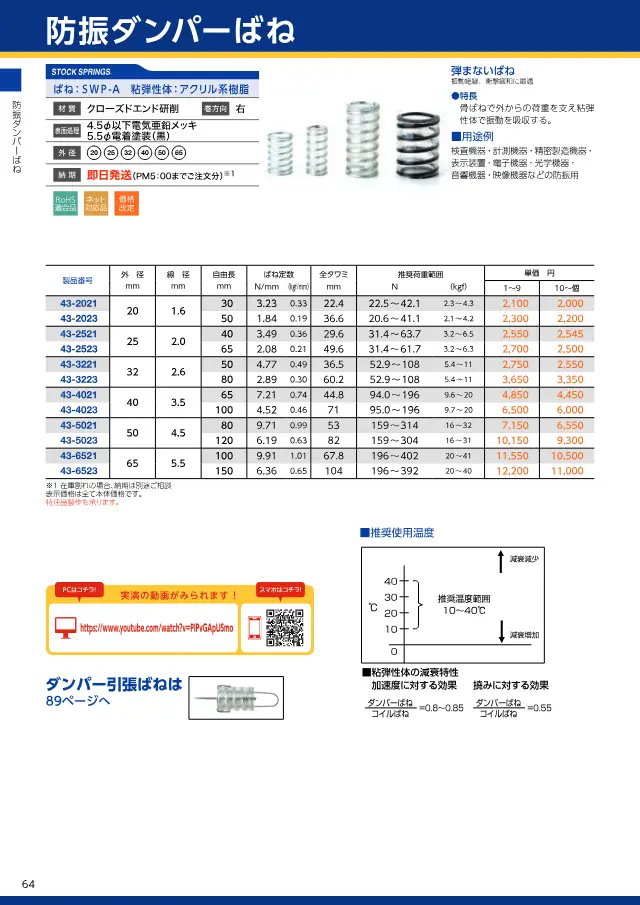
A reduced image of the relevant page is quoted from the document. Copyright belongs to Spring net.Request removal
Specifications
| Outer diameter D | 20〜65 mm |
|---|---|
| Wire diameter d | 1.6〜5.5 mm |
| Free length L | 30〜150 mm |
| Spring constant k | 1.84〜9.91 N/mm |
| Maximum load | 22.5〜402 N |
| Unit price (1-9 pcs) | 2000〜12200 円 |
How to choose Springs
Points to check when selecting, with the values for this product (Vibration-Damping Damper Spring).
-
1. Select the Spring Rate from the Required Force
This product: Spring constant k 1.84〜9.91 N/mmThe spring rate k is the load required to deflect the spring by 1 mm. Multiply it by the deflection at installation and at operation to confirm that the required force can be obtained. Listed products range widely from 0.007 to 9.91 N/mm, and a margin should be allowed for variation, including the spring rate tolerance (for example, ±10%).
-
2. Keep Within the Maximum Load and Deflection Limits
This product: Maximum load 22.5〜402 NUsing the spring beyond its maximum load or maximum deflection causes set (permanent deformation) or breakage. Confirm that the load at the maximum point of the operating stroke is within the maximum load, and for compression springs, that the solid height is not reached.
-
3. Installation Space, Outside Diameter, and Free Length
This product: Outer diameter D 20〜65 mmCheck that the outside diameter fits the hole or housing, and that the inside diameter does not interfere with the shaft it passes over (applicable shaft diameter). The free length is the length under no load; the difference from the installed length is the initial deflection. Because the coil diameter changes under load, allow sufficient clearance.
-
4. Select a Material Suited to the Operating Environment
Piano wire SWP-A has high strength but is prone to rust, and many versions are supplied with rust-preventive oil treatment. For humid environments or environments subject to washing, stainless steel such as SUS304-WPB is a candidate. For strongly corrosive environments such as seawater, titanium is a candidate.
-
5. Extension Springs: Initial Tension and Hook Shape
Close-wound extension springs have initial tension, the load required before the spring begins to extend. For applications requiring movement with a small force, check the initial tension value. Also check that the hook shape, such as reverse loop, 90-degree, or 180-degree, matches how the mating part is engaged.
-
6. Torsion Springs: Angle and Arm Direction
For torsion springs, check the torque at the operating angle (torsion spring rate × angle) and the arm length. The winding direction should match the direction of twist, and it is common to use the spring in the direction that winds it up. For free-size products, also specify the bending direction.
This guide was written by AI based on the listed products' documents and specification items.
Description
A product combining a compression coil spring with a viscoelastic sheet. Exhibits characteristics that suppress vibration transmission more than a coil spring. Recommended operating temperature range: 10 to 40 °C.
Features
- Absorbs vibration and stops oscillation in a short time
- Reduces force acting on equipment
- Stock items shipped same day (orders placed by 5:00 PM)
Applications
- Inspection and measuring equipment
- Precision manufacturing equipment and display devices
- Vibration isolation for electronic, optical, audio, and video equipment
FAQ
- Q. What is the operating temperature range and what are the applications of the Vibration-Damping Damper Spring (SWP-A, viscoelastic body)?
- A. The recommended operating temperature range is 10 to 40 °C. Applications include inspection and measuring equipment, precision manufacturing equipment and display devices, and vibration isolation for electronic, optical, audio, and video equipment.
- Q. How does the Vibration-Damping Damper Spring (SWP-A, viscoelastic body) handle vibration and shock?
- A. It is a vibration-isolating spring combining a bone spring with a viscoelastic body to absorb vibration and shock. It exhibits characteristics that suppress vibration transmission more than a coil spring, stops oscillation in a short time, and reduces force acting on equipment.
- Q. What are the ranges of outer diameter, wire diameter, free length, spring constant, and maximum load for the Vibration-Damping Damper Spring (SWP-A, viscoelastic body)?
- A. Outer diameter D is 20 to 65 mm, wire diameter d is 1.6 to 5.5 mm, free length L is 30 to 150 mm, spring constant k is 1.84 to 9.91 N/mm, and maximum load is 22.5 to 402 N.
Written by AI based on the content of the source documents.
Source documents
-
Catalog
スプリングネット 製品カタログ(ばね類)
178 pages Open page 68
Found on: https://www.samini.co.jp/catalog_list/
Similar products (other manufacturers)
Springs products, ordered by similarity of specifications and applications.
-
Springs
Super Spring Kit
A kit containing springs from the K, D, and DS series. A selection set for prototype design and jig and fixture maintenance.
KS Industries Co., Ltd.
-
Springs
Custom-Made Springs (Special Order Springs)
Custom springs manufactured from a single piece. Can be ordered to specific material, size, shape, and application requirements, with support for prototypes and dedicated replacement springs.
Sammini Co., Ltd.
-
Springs
Custom Torsion Spring
Quotation request form for custom-made torsion springs manufactured based on customer drawings or specifications (material, wire diameter, coil diameter, number of coils, winding direction, arm length, free angle, surface treatment).
Sammini Co., Ltd.
-
Rolling Bearings
Sealed Single-Row Deep Groove Ball Bearings
A series of sealed deep groove ball bearings with bore diameters from 3 to 15 mm, covering small to medium sizes. Specifications are listed for each seal type, such as Z and RS.
SKF
-
Rolling Bearings
Single-Row Tapered Roller Bearings
Dimension table for large single-row tapered roller bearings with bore diameters from 139.700 mm or more and outside diameters up to 1092.200 mm. Lists principal dimensions, basic dynamic load ratings, fatigue load limits, mounting dimensions, and axial factors.
JTEKT Corporation
-
Rolling Bearings
Single-Direction Thrust Tapered Roller Bearing
Thrust tapered roller bearing suited to large axial loads and shock loads. Sizes with bore diameters of 114.3 to 830 mm are listed.
JTEKT Corporation
More products from Spring net
See all →-
Springs
Daruma Pin
Daruma pin made of stainless spring steel wire. Compatible with shaft diameters of 4 to 20 mm, with same-day shipping.
Spring net
-
Springs
Clip Ring
Stainless steel wire retaining ring for shaft diameters of 4 to 16 mm, with same-day shipping available.
Spring net
-
Springs
Bending Process Free Size
Stainless steel wire bent to specified length and angle. Wire diameter 0.5 to 3.5 mm.
Spring net
-
Springs
Ring
Ring made of stainless steel spring wire. Wire diameter 0.6 to 1.6 mm, sold by bag.
Spring net
-
Springs
Anti-Loosening Spring
Stainless steel torsion spring that prevents bolt loosening. Compatible with M5 to M16.
Spring net
-
Springs
Spring Antenna
Stainless steel spring antenna with close-contact coil and straight section. For M3 to M10.
Spring net