3rd Generation Ball Hub Unit (for Driven Wheels)
第3世代 ボールハブユニット / JTEKT Corporation (Official website) / Listed on page 1 of the document
A 3rd generation ball hub unit supporting driven wheels. Combines low torque design with mud water resistance and suits a wide range of vehicles from kei cars to SUVs.
Last verified: (date the content was verified against the source document)
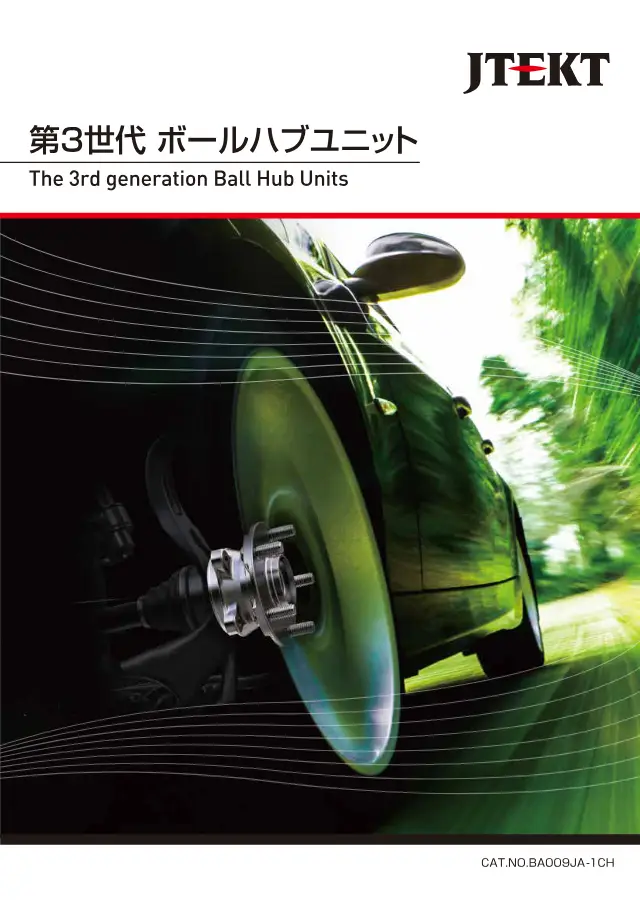
A reduced image of the relevant page is quoted from the document. Copyright belongs to JTEKT Corporation.Request removal
Specifications
| Compatible Shaft Load | 4.9–16.7 kN |
|---|---|
| Wheel mounting hole P.C.D. | 100–139.7 mm |
| Number of wheel bolts | 4~6 本 |
第3世代 ボールハブユニット model comparison
Compare 2 models in the same series by specification.
| Model | Compatible Shaft Load | Wheel mounting hole P.C.D. | Number of wheel bolts |
|---|---|---|---|
| 第3世代 ボールハブユニット(従動輪用) This product | 4.9–16.7 kN | 100–139.7 mm | 4~6 本 |
| 第3世代 ボールハブユニット(駆動輪用) | 6.3–19.7 kN | 100–139.7 mm | 4~6 本 |
How to choose Hub Unit Bearings
Points to check when selecting, with the values for this product (3rd Generation Ball Hub Unit (for Driven Wheels)).
-
1. Select a rating that matches the vehicle axle load
This product: Compatible Shaft Load 4.9–16.7 kNHub unit bearings directly receive the vehicle weight and moment loads during cornering, so confirm that the axle load of the applicable vehicle falls within the product's rated range. The axle load range of the listed products is 4.9 to 19.7 kN. Insufficient margin against the axle load may lead to early flaking and play.
-
2. Match P.C.D. and bolt count to the wheel
This product: Wheel mounting hole P.C.D. 100–139.7 mmThe pitch circle diameter of the wheel mounting holes and the number of hub bolts must match the wheel side, otherwise installation is not possible. The P.C.D. of the listed products is 100 to 139.7 mm, and the bolt count is 4 to 6. Verify against the vehicle's original equipment specifications when selecting.
-
3. Match the generation (structural type) to the vehicle
The first to third generations differ in how they attach to the knuckle and how they are assembled with the hub. Select a generation that suits the vehicle design. The third generation excels in rigidity and weight reduction due to integration, but the bearing cannot be replaced alone and must be replaced as a complete unit.
-
4. Confirm whether it is for a driven or non-driven wheel
Driven-wheel types have a spline hhole in the hub to accommodate the drive shaft. Their shape differs from non-driven types, and they are not interchangeable. Check the classification according to the vehicle's drive system and mounting position, such as FF, FR, or 4WD vehicles.
-
5. Confirm compatibility with ABS sensors
Types with built-in rotation sensors or magnetic encoders supply wheel speed signals to ABS and vehicle stability control systems. If the sensor method on the vehicle side or the presence of a sensor or encoder does not match, the control system will not operate correctly.
-
6. Compare low-torque performance and mud and water resistance
Improved dedicated grease and seal structures have achieved a 50% reduction in rotational torque compared with current products, contributing to better fuel economy and electric vehicle power consumption. On the other hand, reducing seal contact increases the risk of mud and water ingress. Therefore, also check whether mud and water resistance is ensured through structures such as labyrinth designs.
This guide was written by AI based on the listed products' documents and specification items.
Description
A hub unit for driven wheels with 3rd generation structure, featuring an outer ring flange and shaft. Low torque grease and seals with reduced number of contact lips suppress sliding resistance, while labyrinth and oke structures reduce ingress of muddy water. Multiple models with different inner ring bore diameters and mounting dimensions can be selected according to the nominal number.
Features
- Reduced sliding resistance through low torque design
- Improved mud water resistance with labyrinth and oke structures
- Grease with excellent lubricity and fretting resistance
- Outer ring flange shape balancing strength, rigidity and weight reduction
- 3rd generation structure enhancing assembly and reliability
Applications
- Kei cars
- A-segment and B-segment passenger cars
- C-segment passenger cars
- D-segment passenger cars
- E-segment passenger cars
- SUVs and pickup trucks
FAQ
- Q. What types of vehicles can the 3rd Generation Ball Hub Unit (for Driven Wheels) be used on?
- A. It is compatible with kei cars, A-segment and B-segment passenger cars, C-segment passenger cars, D-segment passenger cars, E-segment passenger cars, and SUVs and pickup trucks.
- Q. What are the applicable axle load, wheel mounting hole P.C.D., and number of wheel bolts for the 3rd Generation Ball Hub Unit (for Driven Wheels)?
- A. The applicable axle load is 4.9 to 16.7 kN, the wheel mounting hole P.C.D. is 100 to 139.7 mm, and the number of wheel bolts is 4 to 6.
- Q. How is the mud water resistance and sliding resistance of the 3rd Generation Ball Hub Unit (for Driven Wheels) designed?
- A. Sliding resistance is suppressed by low torque grease and seals with a reduced number of contact lips. Labyrinth and oke structures reduce the ingress of muddy water.
- Q. How should I select the model of the 3rd Generation Ball Hub Unit (for Driven Wheels)?
- A. You can select from multiple models with different inner ring bore diameters and mounting dimensions according to the nominal number.
Written by AI based on the content of the source documents.
Source documents
- Catalog 第3世代 ボールハブユニット Open page 1
Similar products (other manufacturers)
Hub Unit Bearings products, ordered by similarity of specifications and applications.
-
Deep Groove Ball Bearings
Double-Row Deep Groove Ball Bearing
Double-row deep groove ball bearing with bore diameter of 10 to 90 mm. High load capacity, supports radial loads and loads in both axial directions.
SKF
-
Deep Groove Ball Bearings
Sealed Single-Row Deep Groove Ball Bearings, d 17–20 mm
Sealed single-row deep groove ball bearings with bore diameter 17–20 mm. Available with 2Z, 2RZ, 2RS1 and other seal types, including SKF Explorer and energy-efficient variants.
SKF
-
Cylindrical Roller Bearings
RCC Bearing (Sealed Cylindrical Roller Bearing for Railway Vehicle Axle Boxes)
A sealed double-row cylindrical roller bearing unit for railway vehicle axle boxes. Seals at both ends and long-life grease enhance maintainability and reliability.
NSK
-
Needle roller bearings
Needle Roller Bearing with Cage
Needle roller bearing with a cage that guides the rollers. Small diameter with high load capacity, low friction, suitable for high-speed rotation. Also suitable for oscillating applications.
NTN Corporation
-
Needle roller bearings
Full Complement Drawn Cup Needle Roller Bearing
A needle roller bearing without a cage, with a large number of rollers to achieve high load capacity. Suitable for high-load, low-speed, and oscillating applications.
NTN Corporation
More products from JTEKT Corporation
See all →-
Hub Unit Bearings
HUB-LFT Low-Torque Hub Unit
A low-torque hub unit for the four wheels of automobiles. Reduces torque with a dedicated grease and double axial lip seal.
JTEKT Corporation
-
Hub Unit Bearings
3rd Generation Ball Hub Unit (for Drive Wheels)
A 3rd generation ball hub unit supporting drive wheels. Low-friction bearings and seals reduce friction loss by 65% compared with conventional products, contributing to improved EV electric efficiency.
JTEKT Corporation
-
Deep Groove Ball Bearings
Deep Groove Ball Bearing
Single-row ball bearing that accepts radial load and axial load in both directions. Suitable for high-speed rotation and low-vibration applications. Dimension tables cover bore diameters from 100 to 1420 mm.
JTEKT Corporation
-
Angular Contact Ball Bearings
Angular Contact Ball Bearing
Angular contact ball bearings that accept axial loads in one or both directions depending on contact angle. Available as single row and back-to-back or face-to-face combinations (DB, DF), with bore diameters of approximately 100 to 300 mm.
JTEKT Corporation
-
Angular Contact Ball Bearings
Single-Row and Matched-Set Angular Contact Ball Bearings
Large single-row and matched-set angular contact ball bearings with bore diameters of 310 to 670 mm. Capable of simultaneously supporting radial and axial loads.
JTEKT Corporation
-
Angular Contact Ball Bearings
Double-Row Angular Contact Ball Bearing
Double-row angular contact ball bearing with a bore diameter of 120 to 280 mm. Accepts radial and axial loads in both directions.
JTEKT Corporation