Posi-Lock PSL-K (Standard Specification)
PSL-K / Miki Pulley (Official website) / Listed on page 2 of the document
Friction joint that clamps a shaft and hub together by frictional force. Standard specification offering high transmission torque and easy, accurate positioning.
Last verified: (date the content was verified against the source document)
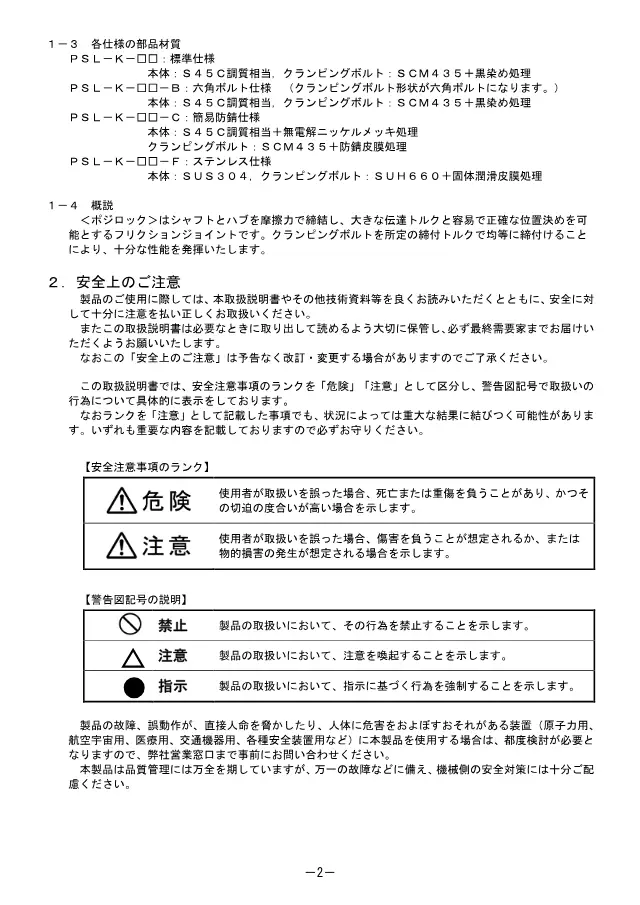
A reduced image of the relevant page is quoted from the document. Copyright belongs to Miki Pulley.Request removal
Specifications
| Body material | Equivalent to S45C quenched and tempered |
|---|---|
| Clamping Bolt Material | SCM435 with black oxide treatment |
| Bolt nominal diameter | M4 to M5 |
| Bolt tightening torque | 2 to 8 N・m |
| Removal screw hole | 2-M4 to 2-M5 |
How to choose Friction joint
Points to check when selecting, with the values for this product (Posi-Lock PSL-K (Standard Specification)).
-
1. Match the Shaft Diameter and Boss Bore Diameter
The applicable shaft diameter d is the outer diameter of the shaft to be installed, and the outer diameter D is the dimension that fits into the boss bore. Friction fastening depends on controlling the fit clearance, so also confirm that the shaft and boss bore can be machined to the manufacturer's specified tolerances and surface roughness.
-
2. Allow a Margin in Allowable Transmission Torque
If the allowable transmission torque T is exceeded, the fastening surfaces slip, causing misalignment and wear. Select based not only on the motor's rated torque but also on the peak torque during startup or impact loads multiplied by a service factor.
-
3. Check Simultaneous Action with Thrust Force
For applications with axial loads, check the allowable thrust force. When torque and thrust force act simultaneously, they share the friction force, so each allowable value may not be usable independently; confirm the manufacturer's handling of combined loads.
-
4. Examine Boss Strength from Side Pressure on the Boss
During fastening, surface pressure acts on the inner surface of the boss, which pushes it outward. Calculate the required boss outer diameter and wall thickness from the boss side pressure and the yield point of the boss material, and for thin-walled bosses or low-strength materials such as aluminum, check for breakage or deformation. Examine the shaft side in the same way using the shaft side pressure.
-
5. Review the Relationship Between Overall Length and Boss Width
The overall length L is the axial fastening length. If the boss width is shorter than this, the fastening surface is insufficient and the performance will not be achieved. Together with the installation space, confirm that the boss width satisfies the overall length and that working space for bolt heads and tools is secured.
-
6. Tighten Evenly to the Specified Tightening Torque
Because transmission performance depends on the clamping force of the clamping bolts, control the tightening torque (1 to 142 N·m for the listed products) with a torque wrench, and tighten evenly in several passes following a diagonal sequence. Also confirm in advance the required tool size and how to use the removal screw holes.
This guide was written by AI based on the listed products' documents and specification items.
Description
Composed of three components: outer sleeve, inner sleeve, and clamping bolts. Fastening is achieved by tightening the clamping bolts evenly to the specified tightening torque. Slippage at the fastened section or exceeding the specified transmission torque may cause damage, so caution is required.
Features
- High transmission torque
- Easy and accurate positioning
- Easy removal using removal screw holes
- Reusable
Applications
- Fastening of shafts and hubs
- Power transmission sections requiring positioning
FAQ
- Q. What are the body material and clamping bolt material of the Posi-Lock PSL-K (Standard Specification)?
- A. The body material is equivalent to S45C quenched and tempered, and the clamping bolt material is SCM435 with black oxide treatment.
- Q. What is the nominal bolt diameter and tightening torque range for fastening the Posi-Lock PSL-K (Standard Specification)?
- A. The nominal bolt diameter is M4 to M5, and the bolt tightening torque is 2 to 8 N·m.
- Q. What applications is the Posi-Lock PSL-K (Standard Specification) suited for, and can it be reused?
- A. It is used for fastening shafts and hubs and for power transmission sections requiring positioning. It enables high transmission torque and easy, accurate positioning, and is reusable.
- Q. How should the Posi-Lock PSL-K (Standard Specification) be removed?
- A. It can be easily removed using the removal screw holes (2-M4 to 2-M5).
- Q. What should be noted when fastening the Posi-Lock PSL-K (Standard Specification)?
- A. Slippage at the fastened section or exceeding the specified transmission torque may cause damage, so caution is required. Tighten the clamping bolts evenly to the specified tightening torque.
Written by AI based on the content of the source documents.
Source documents
- Manual ポジロック PSL-K 取扱説明書 8 pages Open page 2
Similar products (other manufacturers)
Friction joint products, ordered by similarity of specifications and applications.
-
Drive shaft
Drive Shaft for Rolling Mills (Block Type)
A high-strength, long-life drive shaft that drives rolls in rolling mills. Used under demanding conditions such as plate rolling mills and hot rolling mills.
JTEKT Corporation
-
Torque limiter
Hyper Coupling (Torque Limiter)
A torque limiter that protects rolling mill drive systems from excessive torque. Improves operating accuracy and durability, and shortens recovery time.
JTEKT Corporation
-
Chain
Ultra Super Chain RF100-US-1
Model: RF100-US-1
Heavy-duty drive chain with 31.75 mm pitch. Minimum tensile strength 149 kN, maximum allowable tension 39.2 kN.
Tsubakimoto Chain Co.
-
Chain
Ultra Super Chain RF120-US-1
Model: RF120-US-1
High-strength drive chain with 38.10 mm pitch. Minimum tensile strength 213 kN, maximum allowable tension 53.9 kN.
Tsubakimoto Chain Co.
More products from Miki Pulley
See all →-
Friction joint
Posi-Lock PSL-D
Friction joint that clamps a shaft and hub together by frictional force. Tightening the clamping bolts evenly to the specified torque provides high transmission torque and accurate positioning. Sizes range from model 6 to 50.
Miki Pulley
-
Friction joint
Posi-Lock PSL-D-C (Simple Anti-Corrosion Specification)
Simple anti-corrosion specification version of the PSL-D. The body is electroless nickel plated, and the clamping bolts are treated with Geomet coating to enhance corrosion resistance. Available from size 16 and above.
Miki Pulley
-
Friction joint
Posilock PSL-G-19
Model: PSL-G-19 / PSL-G-19-C
Friction joint that fastens a shaft and hub by frictional force. Tightened with clamping bolts.
Miki Pulley
-
Friction joint
Posilock PSL-G-20
Model: PSL-G-20 / PSL-G-20-C
Friction joint that clamps shaft and hub together by frictional force. Tightened with clamping bolts.
Miki Pulley
-
Friction joint
POSILOCK PSL-G-22
Model: PSL-G-22 / PSL-G-22-C
A friction joint that clamps a shaft and hub together by friction force. Tightened with clamping bolts.
Miki Pulley
-
Friction joint
POSILOCK PSL-G-24
Model: PSL-G-24 / PSL-G-24-C
Friction joint that clamps a shaft and hub by friction force, tightened with clamping bolts.
Miki Pulley