Double-Acting Rotary Seal R05-A
Model R05-A / ロータリーシール / SKF (Official website) / Listed on page 53 of the document
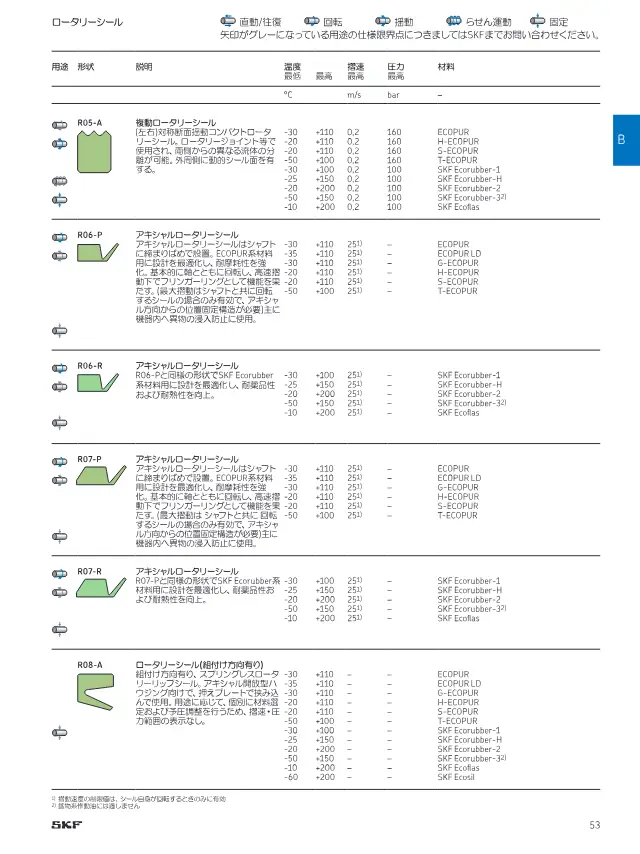
Compact oscillating rotary seal with symmetrical cross-section. Features a dynamic sealing surface on the outer periphery.
Last verified: (date the content was verified against the source document)
A reduced image of the relevant page is quoted from the document. Copyright belongs to SKF.Request removal
Specifications
| Operating Temperature Range | -50~+110 °C |
|---|---|
| Maximum Sliding Speed | 0.2 m/s |
| Maximum Operating Pressure | 160 bar |
ロータリーシール model comparison
Compare 25 models in the same series by specification.
| Model | Maximum Sliding Speed | Maximum Operating Pressure | Operating Temperature Range |
|---|---|---|---|
| R01-AF2 | 0.5 m/s | 15 bar | — |
| R02-P | 0.2 m/s | — | 0~+80 °C |
| R02-R | 0.2 m/s | — | -50~+200 °C |
| R03-P | 0.2 m/s | 400 bar | -40~+100 °C |
| R03-R | 0.2 m/s | 250 bar | -50~+200 °C |
| R04-A | 0.2 m/s | 160 bar | -50~+110 °C |
| R05-A This product | 0.2 m/s | 160 bar | -50~+110 °C |
| R06-P | 25 m/s | — | -50~+110 °C |
| R06-R | 25 m/s | — | -50~+200 °C |
| R07-P | 25 m/s | — | -50~+110 °C |
| R07-R | 25 m/s | — | -50~+200 °C |
| R08-A | — | — | -60~+200 °C |
| R08-P | 2.5 m/s | — | -50~+110 °C |
| R08-R | 7.5 m/s | — | -60~+200 °C |
| R09-F | 0.4 m/s | 350 bar | -20~+200 °C |
| R09-FS | 0.4 m/s | 350 bar | -30~+200 °C |
| R10-F | 0.4 m/s | 350 bar | -20~+200 °C |
| R10-FS | 0.4 m/s | 350 bar | -30~+200 °C |
| R11-F | 20 m/s | 5 bar | -200~+260 °C |
| R19-F | 2 m/s | 150 bar | -200~+260 °C |
| R19-FX | 2 m/s | 150 bar | -200~+260 °C |
| R30-A | 0.5 m/s | — | -25~+200 °C |
| TX | 11 m/s | — | -30~+150 °C |
| TY | 11 m/s | — | -30~+150 °C |
| TZ | 11 m/s | — | -30~+150 °C |
How to choose Rotary Seals
Points to check when selecting, with the values for this product (R05-A).
-
1. Select a size that matches the shaft diameter
Select seals to match the diameter of the shaft on which they are installed. Listed products cover a shaft diameter range of 5 to 1000 mm, and the applicable range differs by type. Shaft tolerance and surface roughness also affect sealing performance and wear, so check the recommended groove dimensions together with the shaft diameter.
-
2. Confirm the peripheral speed is within the limit
This product: Maximum Sliding Speed 0.2 m/sSliding speed is evaluated as the peripheral speed calculated from shaft diameter and rotational speed. The listed upper limits range widely from 0.2 to 25 m/s, and higher speeds make lips and slide rings more prone to wear from frictional heat. Choose a product with a margin above the actual peripheral speed, for example from PTFE spring-loaded types recommended for low friction and high speed.
-
3. Match the pressure rating and single- or double-acting design
This product: Maximum Operating Pressure 160 barThe maximum operating pressure of listed products is 5 to 400 bar. Springless lip seals are mainly intended for grease retention and foreign matter exclusion and are not suitable for high pressure. For rotary joints and rotary pivots subject to high pressure or pressure from both sides, consider double-acting PTFE seals combined with O-rings.
-
4. Select materials suited to temperature and fluid
Rubber-based materials such as NBR offer excellent elasticity, while PTFE offers superior chemical resistance, heat resistance and low friction. PTFE is often selected for chemical and pharmaceutical applications and high-temperature environments. Check that the O-ring material of the energizer is compatible with both the operating temperature range and the fluid used.
-
5. Check the cross-section dimensions for the groove
Cross-section dimensions range from 0.85 to 10.5 mm and must match the width and depth of the housing groove. When replacing existing equipment, match the cross-section dimensions as well as the shaft diameter, and confirm that the squeeze is appropriate.
-
6. Determine whether a split design is required
Split designs that can be divided into two halves are available for plummer blocks, allowing replacement without removing the shaft and reducing maintenance effort. When using a one-piece type, confirm during the design stage whether it can be inserted from the shaft end and whether chamfers or tooling are provided to avoid damaging the lip.
This guide was written by AI based on the listed products' documents and specification items.
Description
Separates fluids of different types on each side in rotary joints and similar applications. Materials can be selected from ECOPUR series and SKF Ecorubber series.
Features
- Separation of fluids on both sides
- Compact
Applications
- Manufacturing equipment
FAQ
- Q. What are the operating temperature range and maximum sliding speed of the R05-A?
- A. The operating temperature range is -50 to +110 °C, and the maximum sliding speed is 0.2 m/s.
- Q. What is the maximum operating pressure of the R05-A?
- A. The maximum operating pressure is 160 bar.
- Q. What applications is the R05-A suited for?
- A. It is a rotary seal used in manufacturing equipment. It is used to separate fluids of different types on each side in rotary joints and similar applications.
- Q. How can the material of the R05-A be selected?
- A. You can select from ECOPUR series and SKF Ecorubber series materials.
- Q. What are the cross-sectional shape and features of the R05-A?
- A. It is a compact oscillating rotary seal with a symmetrical cross-section and a dynamic sealing surface on the outer periphery. It supports separation of fluids on both sides and is compact.
Written by AI based on the content of the source documents.
Source documents
-
Catalog
切削加工シール製品ラインアップ
84 pages Open page 53
Found on: https://azuma-eg.com/catalogue/
Similar products (other manufacturers)
Rotary Seals products, ordered by similarity of specifications and applications.
-
Oil Seals
Low-Temperature Compatible Oil Seal
Oil seal using hydrogenated nitrile, acrylic, and nitrile rubber materials for low-temperature applications.
JTEKT Corporation
-
Oil Seals
Oil Seals for Steel Industry Equipment
Environment-resistant oil seals available by type for continuous casting equipment and rolling mills.
JTEKT Corporation
More products from SKF
See all →-
Rotary Seals
Rotary Seals
A product group of seals used in rotating motion parts. Listed in the table of contents of this document, but the body text is not included in the excerpt.
SKF
-
Rotary Seals
Rotary Seal (R09 Double-Acting Rotary Seal, O-Ring and PTFE Combination)
Model: R09
Double-acting rotary seal for rotary pivots. Combines an O-ring and a PTFE seal, suitable for high-pressure applications.
SKF
-
Rotary Seals
Rotary Seal (R19 Single-Acting Rotary Seal, Spring-Loaded PTFE)
Model: R19
Single-acting rotary seal for bearing protection in the chemical and pharmaceutical industries. Spring-loaded PTFE provides low friction, chemical resistance, heat resistance, and suitability for high-speed sliding.
SKF
-
Rotary Seals
Rotary Shaft Seal R01-AF2
Model: R01-AF2
A rotary seal that is more robust and has higher contact force than the R01-AF, with improved pressure resistance.
SKF
-
Rotary Seals
Rotary Shaft Seal R02-P
Model: R02-P
Rotary lip seal with auxiliary lip. Prevents intrusion of external dust and debris.
SKF
-
Rotary Seals
Rotary Shaft Seal R02-R
Model: R02-R
Rotary lip seal with auxiliary lip. Uses SKF Ecorubber-based materials to enhance chemical and heat resistance.
SKF