PTFE Jacket Valve Stem Seal R30-A
Model R30-A / ロータリーシール / SKF (Official website) / Listed on page 55 of the document
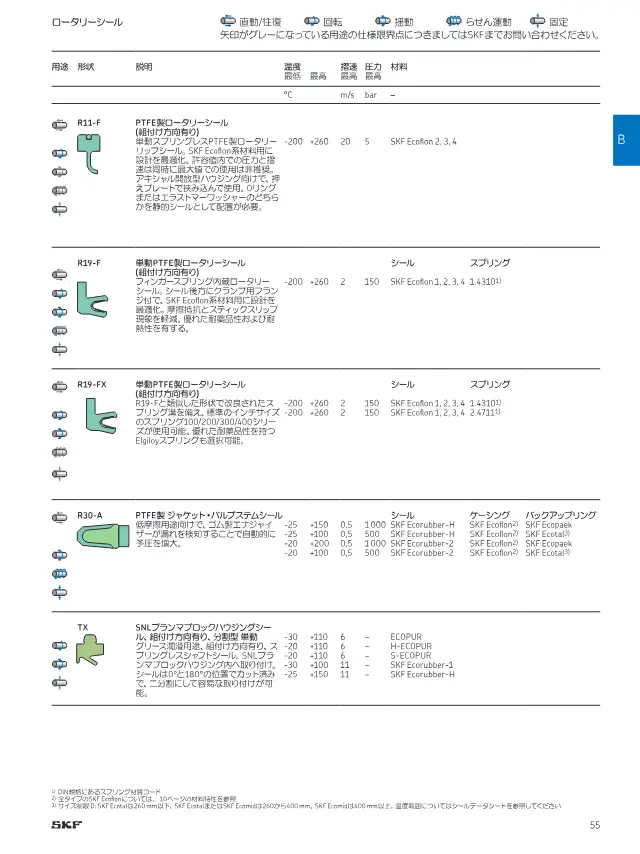
PTFE valve stem seal for low-friction applications. The rubber energizer automatically increases preload when leakage is detected.
Last verified: (date the content was verified against the source document)
A reduced image of the relevant page is quoted from the document. Copyright belongs to SKF.Request removal
Specifications
| Operating Temperature Range | -25~+200 °C |
|---|---|
| Maximum Sliding Speed | 0.5 m/s |
| Maximum Pressure | 1000 bar |
ロータリーシール model comparison
Compare 25 models in the same series by specification.
| Model | Operating Temperature Range | Maximum Sliding Speed | Maximum Operating Pressure |
|---|---|---|---|
| R01-AF2 | — | 0.5 m/s | 15 bar |
| R02-P | 0~+80 °C | 0.2 m/s | — |
| R02-R | -50~+200 °C | 0.2 m/s | — |
| R03-P | -40~+100 °C | 0.2 m/s | 400 bar |
| R03-R | -50~+200 °C | 0.2 m/s | 250 bar |
| R04-A | -50~+110 °C | 0.2 m/s | 160 bar |
| R05-A | -50~+110 °C | 0.2 m/s | 160 bar |
| R06-P | -50~+110 °C | 25 m/s | — |
| R06-R | -50~+200 °C | 25 m/s | — |
| R07-P | -50~+110 °C | 25 m/s | — |
| R07-R | -50~+200 °C | 25 m/s | — |
| R08-A | -60~+200 °C | — | — |
| R08-P | -50~+110 °C | 2.5 m/s | — |
| R08-R | -60~+200 °C | 7.5 m/s | — |
| R09-F | -20~+200 °C | 0.4 m/s | 350 bar |
| R09-FS | -30~+200 °C | 0.4 m/s | 350 bar |
| R10-F | -20~+200 °C | 0.4 m/s | 350 bar |
| R10-FS | -30~+200 °C | 0.4 m/s | 350 bar |
| R11-F | -200~+260 °C | 20 m/s | 5 bar |
| R19-F | -200~+260 °C | 2 m/s | 150 bar |
| R19-FX | -200~+260 °C | 2 m/s | 150 bar |
| R30-A This product | -25~+200 °C | 0.5 m/s | — |
| TX | -30~+150 °C | 11 m/s | — |
| TY | -30~+150 °C | 11 m/s | — |
| TZ | -30~+150 °C | 11 m/s | — |
How to choose Seals
Points to check when selecting, with the values for this product (R30-A).
-
1. Select the inner diameter to suit the mating part and groove
An O-ring must be selected with an inner diameter matched to the shaft diameter and groove dimensions it fits. Selecting by a nominal size compliant with standards such as JIS B 2401 makes it easier to align with groove design. Listed products cover inner diameters from 15 to 1055 mm, and there are application-specific series such as those for vacuum flanges.
-
2. Check cross-section diameter and squeeze
The cross-section diameter (wire diameter) and groove depth determine whether an appropriate squeeze (compression amount) can be achieved. An incorrect fit causes leakage, extrusion or early deterioration. O-rings for vacuum flanges come in series such as 4 mm, 6 mm and 10 mm, so select by checking against the groove dimensions.
-
3. Select a material suited to the fluid and environment
Material is selected based on resistance to the sealed fluid. Rubber materials differ greatly in oil resistance, weather resistance and chemical resistance depending on type, while resins such as PTFE offer excellent chemical resistance and low friction. For vacuum applications, low outgassing should also be considered. Verify against a fluid-to-material compatibility chart.
-
4. Confirm operation is within the service temperature range
This product: Operating Temperature Range -25~+200 °CSeal materials harden and degrade at high temperatures and lose elasticity at low temperatures, reducing sealing performance. Confirm that the maximum and minimum operating temperatures fall within the service temperature range, and if the seal is continuously exposed to high temperatures, also check the continuous service temperature. Temperature ranges may differ by grade even within the same product.
-
5. Allow margin below the maximum pressure
This product: Maximum Pressure 1000 barIf the operating pressure exceeds the maximum pressure, the seal may extrude into the gap and fail. Check that pressure, including surge pressure (momentary pressure rise), stays within the maximum pressure. Listed products include an example with a maximum pressure of 1000 bar; at high pressures, consider gap control in the groove and the use of backup rings.
-
6. Judge sliding applications by the limit PV value
For dynamic seals used in reciprocating or rotating motion, wear increases sharply when the PV value, the product of pressure and speed, exceeds the limit PV value. Listed products include examples with a limit PV value of 1.5 MPa·m/s and a maximum sliding speed of 0.5 m/s. Calculate from the operating pressure and speed, and confirm that both upper limits are met.
This guide was written by AI based on the listed products' documents and specification items.
Description
Configured by combining a casing and backup ring, using SKF Ecorubber-H or SKF Ecorubber-2 as the energizer.
Features
- Automatic preload increase
- Low friction
Applications
- Manufacturing equipment
FAQ
- Q. What are the operating temperature range and maximum sliding speed of the R30-A?
- A. The operating temperature range is -25 to +200 °C, and the maximum sliding speed is 0.5 m/s.
- Q. What is the maximum pressure of the R30-A?
- A. The maximum pressure is 1000 bar.
- Q. What is the configuration of the R30-A, and which materials are used for the energizer?
- A. It is configured by combining a casing and backup ring, and uses SKF Ecorubber-H or SKF Ecorubber-2 for the energizer.
- Q. How does the automatic preload increase of the R30-A work?
- A. The rubber energizer detects leakage and automatically increases the preload.
- Q. What applications is the R30-A suited for?
- A. It is a valve stem seal for low-friction applications, and its application is manufacturing equipment.
Written by AI based on the content of the source documents.
Source documents
-
Catalog
切削加工シール製品ラインアップ
84 pages Open page 55
Found on: https://azuma-eg.com/catalogue/
Similar products (other manufacturers)
Seals products, ordered by similarity of specifications and applications.
-
Seals
Bearee™ Sliding Seal
A resin-based sliding seal with excellent sealing performance against gases and oils, along with wear resistance and low friction. Limiting PV and operating temperature vary by grade.
NTN Corporation
-
Seals
O-Ring (for V Vacuum Flanges)
JIS B 2401 compliant O-ring for vacuum flanges. Inner diameter range from 15 mm to 1055 mm.
JTEKT Corporation
-
Rolling Bearings
EXSEV®-SK
Stainless steel bearing pre-packed with lithium-based KHD grease, suitable for environments with slight corrosion.
JTEKT Corporation
-
Plain Bearings
Bearee™ M Liner Bearing (ML Type)
Resin slit liner bearing with bore sizes from 4 mm to 70 mm. A plain bearing installed between shaft and housing, with recommended operating clearance dimensions shown.
NTN Corporation
-
Springs
Super Spring Kit
A kit containing springs from the K, D, and DS series. A selection set for prototype design and jig and fixture maintenance.
KS Industries Co., Ltd.
-
Pins & Shafts
Super Shaft
Precision SUS304 stainless steel shaft, diameter 0.1–6.0 mm, length 2–65 mm. Available for immediate shipment in small lot packs.
KS Industries Co., Ltd.
More products from SKF
See all →-
Deep Groove Ball Bearings
SKF Explorer 6309
Model: 6309
Deep groove ball bearing with a 45 mm bore and 100 mm outside diameter. With a basic dynamic load rating of 55.3 kN, the calculation example uses it for life evaluation at 3000 r/min.
SKF
-
Self-aligning ball bearings
SKF Explorer Spherical Roller Bearing 24026-2CS2/VT143
Model: 24026-2CS2/VT143
Sealed spherical roller bearing. Used for verification examples of dynamic and static loads in heavy material handling equipment in steel plants.
SKF
-
Deep Groove Ball Bearings
Deep Groove Ball Bearing
A versatile, non-separable ball bearing suitable for high and ultra-high speeds. It accepts both radial and axial loads and requires little maintenance.
SKF
-
Rolling Bearings
SKF Explorer Deep Groove Ball Bearing
A high-performance single-row deep groove ball bearing with reduced friction, noise and vibration, and extended service life. It uses the same designation system as conventional standard bearings and is marked with an asterisk in product tables.
SKF
-
Rolling Bearings
SKF E2 Energy-Efficient Deep Groove Ball Bearing
Energy-efficient deep groove ball bearing that reduces friction torque by more than 30% compared with the SKF Explorer bearing of the same dimensions.
SKF
-
Rolling Bearings
SKF Quiet Running Deep Groove Ball Bearing (VQ658)
Model: VQ658
A quiet running deep groove ball bearing for demanding noise requirements such as wind turbine generators.
SKF