Posi-Lock PSL-K Standard Type
Model PSL-K / ポジロック PSL-K / Miki Pulley (Official website) / Listed on page 4 of the document
Flanged standard type that clamps shaft and hub through the wedge action of tapered surfaces. Accommodates shaft diameters of φ6 to 42 mm.
Last verified: (date the content was verified against the source document)
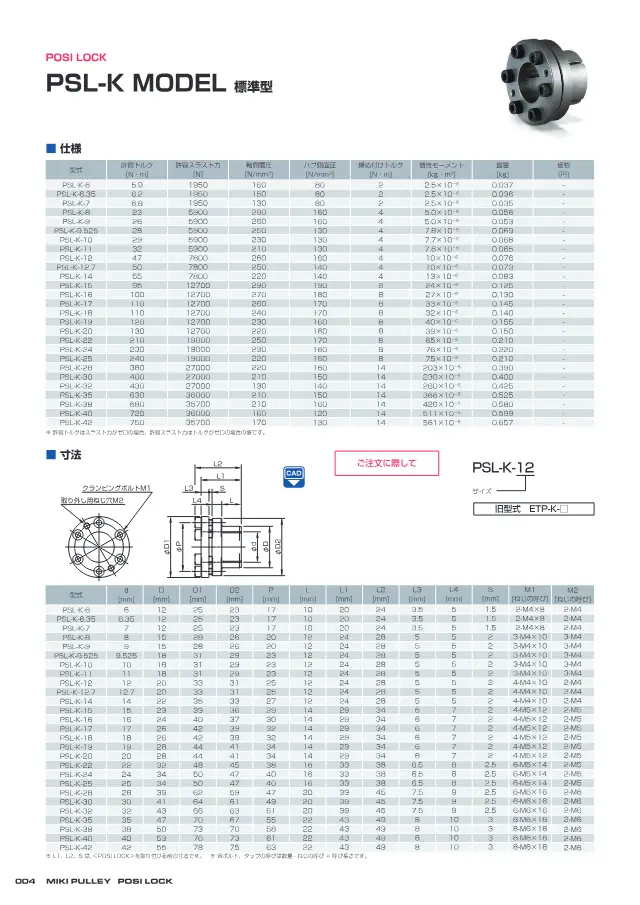
A reduced image of the relevant page is quoted from the document. Copyright belongs to Miki Pulley.Request removal
Specifications
| Applicable shaft diameter | φ6~42 mm |
|---|---|
| Maximum Allowable Torque | 750 N・m |
| Maximum allowable thrust force | 36000 N |
| Operating Ambient Temperature | -40~150 ℃ |
ポジロック PSL-K model comparison
Compare 4 models in the same series by specification.
| Model | Maximum Allowable Torque | Applicable shaft diameter | Maximum allowable thrust force | Operating Ambient Temperature |
|---|---|---|---|---|
| PSL-K This product | 750 N・m | φ6~42 mm | 36000 N | -40~150 ℃ |
| PSL-K(B) | 750 N・m | φ6~42 mm | 36000 N | -40~150 ℃ |
| PSL-K(C) | 750 N・m | φ6~42 mm | 36000 N | -40~150 ℃ |
| PSL-K(F) | 504 N・m | φ6~42 mm | 28800 N | -40~150 ℃ |
How to choose Shaft coupling
Points to check when selecting, with the values for this product (PSL-K).
-
1. Allow Margin for Rated Torque
Select a size whose continuous operating torque is equal to or greater than the load torque transmitted during continuous operation. Check by multiplying the motor's rated torque by a factor corresponding to the frequency of starts and stops and load fluctuations. Listed products have a rated torque of 0.5 to 150 N·m.
-
2. Verify Peak Torque at Startup Against Maximum Allowable Torque
This product: Maximum Allowable Torque 750 N・mLarge instantaneous torques occur during rapid acceleration and deceleration of servo motors, startup, and emergency stops. Confirm that these peak values do not exceed the maximum allowable torque. For taper clamping elements, this value serves as a guide to the torque the clamp can hold.
-
3. Match Shaft Diameter to Machinable Bore Diameter
Confirm that the driving and driven shaft diameters fall within the applicable shaft diameter range. When machining pilot-bored products, confirm the bore is within the maximum bore diameter d. If the two shaft diameters differ, check that both hubs have matching bores.
-
4. Do Not Exceed Maximum Rotational Speed
Confirm that the maximum operating speed is at or below the coupling's maximum rotational speed. Larger outer diameters are more susceptible to centrifugal force, and the allowable speed tends to be lower. Listed products range from 3600 to 18000 min-1.
-
5. Check Allowable Mounting Misalignment
Confirm that the parallel misalignment expected from assembly accuracy is within the maximum allowable eccentricity (0.1 to 0.4 mm for listed products). Compare angular misalignment against the maximum allowable declination (0.5 to 1°). Exceeding these allowances causes early wear of the buffer and increased bearing load.
-
6. Select Hub Material and Inertia for Responsiveness
Aluminum alloy hubs are lightweight, low-inertia, and less likely to impair the responsiveness of servo and stepping motors. Cast iron hubs have high inertia and tend to provide stable rotation, and nickel-plated products offer corrosion resistance. In environments requiring rust prevention, also check whether surface treatment is applied.
This guide was written by AI based on the listed products' documents and specification items.
Description
Clamps the shaft and hub completely through the wedge action of the tapered surfaces of the outer sleeve and inner sleeve. The groove in the inner sleeve enhances the wedge effect, enabling high transmission torque. Keyway machining is not required, and the shaft and hub can be assembled with high concentricity.
Features
- No keyway machining required
- High transmission torque
- High shaft-to-hub concentricity
Applications
- Shaft-to-hub clamping
- Power transmission sections
FAQ
- Q. Which shaft diameters does the Posi-Lock PSL-K Standard Type (model PSL-K) accommodate?
- A. The applicable shaft diameter is φ6 to 42 mm.
- Q. What are the maximum allowable torque and maximum allowable thrust force of the PSL-K?
- A. The maximum allowable torque is 750 N・m, and the maximum allowable thrust force is 36000 N.
- Q. What ambient operating temperature range can the PSL-K be used in?
- A. The ambient operating temperature range is -40 to 150 ℃.
- Q. How does the PSL-K clamp the shaft and hub, and is keyway machining necessary?
- A. It clamps the shaft and hub through the wedge action of the tapered surfaces. Keyway machining is not required.
- Q. Can the PSL-K be assembled with high shaft-to-hub concentricity, and what applications is it suited for?
- A. It can be assembled with high shaft-to-hub concentricity. It is used for shaft-to-hub clamping and power transmission sections.
Written by AI based on the content of the source documents.
Source documents
- Catalog POSI LOCK PSL-G / PSL-D 設計上の確認事項・製品仕様 24 pages Open page 4
Similar products (other manufacturers)
Shaft coupling products, ordered by similarity of specifications and applications.
-
Drive shaft
Drive Shaft for Rolling Mills (Block Type)
A high-strength, long-life drive shaft that drives rolls in rolling mills. Used under demanding conditions such as plate rolling mills and hot rolling mills.
JTEKT Corporation
-
Torque limiter
Hyper Coupling (Torque Limiter)
A torque limiter that protects rolling mill drive systems from excessive torque. Improves operating accuracy and durability, and shortens recovery time.
JTEKT Corporation
-
Chain
Ultra Super Chain RF100-US-1
Model: RF100-US-1
Heavy-duty drive chain with 31.75 mm pitch. Minimum tensile strength 149 kN, maximum allowable tension 39.2 kN.
Tsubakimoto Chain Co.
-
Chain
Ultra Super Chain RF120-US-1
Model: RF120-US-1
High-strength drive chain with 38.10 mm pitch. Minimum tensile strength 213 kN, maximum allowable tension 53.9 kN.
Tsubakimoto Chain Co.
More products from Miki Pulley
See all →-
Shaft coupling
SERVORIGID SRG
Ultra-high rigidity rigid coupling for servo motors. Its structure does not absorb shaft misalignment, achieving high torsional rigidity and low inertia.
Miki Pulley
-
Shaft coupling
Posi-Lock PSL-K(B) Hex Bolt Type
Model: PSL-K(B)
Hex bolt type of PSL-K. Applicable shaft diameter φ6 to 42 mm, maximum allowable torque 750 N・m.
Miki Pulley
-
Shaft coupling
Posi-Lock PSL-K(C) Simple Anti-Corrosion Specification
Model: PSL-K(C)
Simple anti-corrosion specification of PSL-K with electroless nickel plating. Applicable shaft diameter φ6 to 42 mm.
Miki Pulley
-
Shaft coupling
Posilock PSL-K(F) Stainless Steel Type
Model: PSL-K(F)
Stainless steel body version of the PSL-K. Applicable shaft diameter φ6 to 35 mm.
Miki Pulley
-
Shaft coupling
POSILOCK PSL-G Standard Type
Model: PSL-G
Heavy-duty clamping element with interchangeability with other manufacturers' products. Applicable shaft diameter φ19 to 120 mm, maximum allowable torque 13500 N・m.
Miki Pulley
-
Shaft coupling
Posi-Lock PSL-G(C) Simple Anti-Corrosion Specification
Model: PSL-G(C)
Simple anti-corrosion specification of PSL-G with electroless nickel plating. Applicable shaft diameter φ19 to 60 mm.
Miki Pulley