Standard Slit Collar / Standard Separate Collar
SCS / SCSS / Iwata Seisakusho Co., Ltd. (Official website) / Listed on page 1 of the document
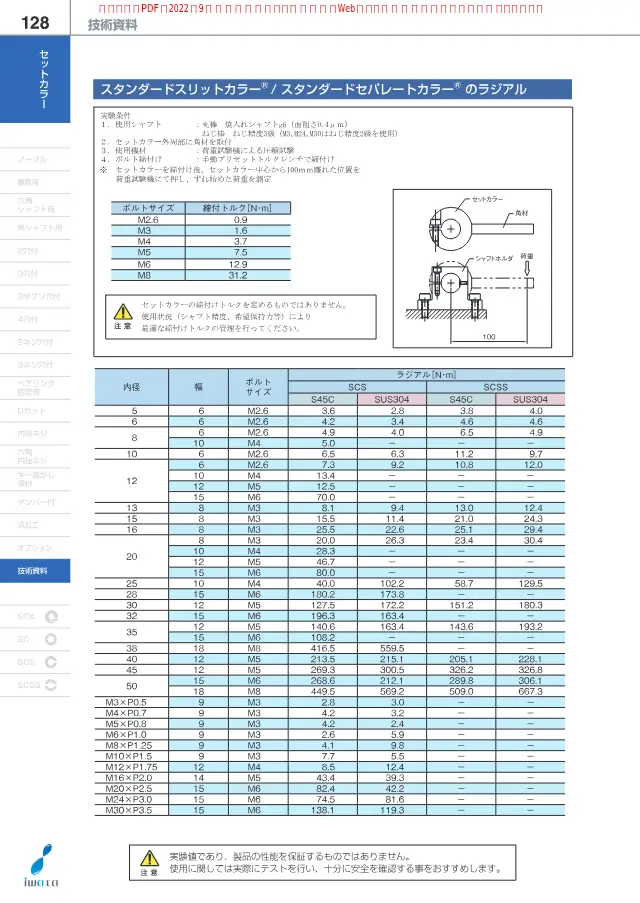
Set collars mounted on shafts for positioning and fixing. Available in bore sizes of 5 to 50 mm and widths of approximately 6 to 18 mm. Secured to the shaft by bolt tightening. The document presents experimental values for tightening torque and radial load.
Last verified: (date the content was verified against the source document)
A reduced image of the relevant page is quoted from the document. Copyright belongs to Iwata Seisakusho Co., Ltd..Request removal
Specifications
| Tightening torque | 0.9 N·m |
|---|---|
| Permissible radial load | 3.6〜449.5 N |
How to choose Set collar
Points to check when selecting, with the values for this product (Standard Slit Collar / Standard Separate Collar).
-
1. Select a bore matching the shaft diameter
Select the bore d to match the applicable shaft diameter. Listed products cover a range of φ5 to 110. Because the combination of shaft tolerance and collar bore tolerance affects clamping force and ease of fitting, check the bore tolerance as well as the shaft diameter.
-
2. Confirm the required axial holding force
The allowable thrust load is the axial load that can be held without slipping axially, and listed products range from 2300 to 149040 N. Even with the same bore, values differ by type; for example, at φ30 there are products rated at 5400 N and 2300 N. Select a model with sufficient margin over the axial load applied.
-
3. Also check rotational holding force
This product: Permissible radial load 3.6〜449.5 NThe allowable radial load is the torque that can be held without slipping in the rotational direction, and listed products range from 3.6 to 449.5 N·m. In applications where torque or rotational force acts on the collar, confirm that this value exceeds the operating conditions.
-
4. Choose the clamping method based on how often it is adjusted
For positions that change frequently, the lever type is convenient because no tools are required, but its holding force is lower than with bolt tightening. The listed lever-tightened thrust load is 780 to 2300 N. If the shaft must not be damaged, select the clamp or wedge type.
-
5. Tighten to the recommended torque
This product: Tightening torque 0.9 N·mThe holding forces in the catalog are values obtained when tightened to the recommended tightening torque. Listed products range from 0.9 to 267.2 N·m, and the value varies greatly with bolt size. Using a torque wrench to observe the specified value helps prevent loosening and damage to the body.
-
6. Select material and surface treatment suited to the environment
S45C offers high strength and is protected against rust by black oxide or electroless nickel plating. For humid environments or areas with washdown, SUS304 is chosen, and for weight reduction, aluminum alloys such as A2017 are selected. However, holding force varies with material, so check it together with the load values.
This guide was written by AI based on the listed products' documents and specification items.
Description
Set collars with a slit structure that clamp and hold the shaft when tightened. The document lists experimental radial load values by bore and bolt size for each material: SCS (S45C and SUS304) and SCSS (S45C and SUS304). Tests were conducted by pressing a square bar against a round bar (hardened shaft) and measuring the load with a load testing machine. These values are not performance guarantees. In actual use, appropriate tightening torque must be managed, taking into account shaft accuracy, holding force, and other factors.
FAQ
- Q. What are the tightening torque and allowable radial load of Standard Slit Collar (SCS)?
- A. The tightening torque is 0.9 N·m. The allowable radial load ranges from 3.6 to 449.5 N. However, these are experimental values obtained by pressing a square bar against a round bar (hardened shaft) with a load testing machine, and they are not performance guarantees.
- Q. Under what conditions were the allowable radial loads of SCS and SCSS measured?
- A. The values are based on experiments in which a square bar was pressed against a round hardened shaft and the load was measured with a load testing machine. The document lists values by bore and bolt size for SCS (S45C and SUS304) and SCSS (S45C and SUS304).
- Q. What should be noted when actually using SCS and SCSS?
- A. Since these are not performance guarantees, appropriate tightening torque must be managed in actual use, taking into account shaft accuracy, holding force, and other factors.
Written by AI based on the content of the source documents.
Source documents
-
Catalog
セットカラー 技術資料 128 スタンダードスリットカラー / スタンダードセパレートカラーのラジアル
1 pages Open page 1
Found on: https://www.iwata-fa.jp/technicaldata
Similar products (other manufacturers)
Set collar products, ordered by similarity of specifications and applications.
-
Set collar
Set Collar
Steel and stainless steel collar for fixing to a shaft. Bore diameter range 6 to 50 mm.
Spring net
-
Damper
Automotive Friction Damper
A component that increases gear drag resistance using the friction torque of rubber, suppressing gear rattle noise during idling.
JTEKT Corporation
-
Damper
Vibration Damper Tension Spring 44 Series
A vibration-isolating tension spring that supports the load with a frame spring and absorbs vibration with a viscoelastic body. Natural frequency: 3.4 to 7.5 Hz.
Spring net
-
Chock
SKF Vibracon
Chock for rotating equipment with self-aligning capability. Helps eliminate soft foot and reduce foundation costs.
SKF
-
Shim
Machine Shim TMAS Series
Reusable stainless steel shims for vertical alignment of machinery. Thickness is marked on each shim, supplied in packs of 10.
SKF
More products from Iwata Seisakusho Co., Ltd.
See all →-
Set collar
Standard Products (Machine Elements, Safety Products, Painting Jigs)
Standard parts including set collars, shims, washers, brackets and more than 45,000 part numbers kept in stock for immediate shipment.
Iwata Seisakusho Co., Ltd.
-
Set collar
Standard Slit Collar / Standard Separate Collar Technical Data (Normal and Thrust)
Test values for axial thrust (push-out load) and bolt tightening torque of set collars fixed to shafts. Reference values by material are provided for each size with bore diameter from 5 to 110 mm.
Iwata Seisakusho Co., Ltd.
-
Set collar
Standard Separate Collar for Hexagonal Shaft / Square Shaft
Separate-type set collar for hexagonal and square shafts. Thrust test values are provided for bore diameters of 8 to 25 mm.
Iwata Seisakusho Co., Ltd.
-
Set collar
Standard Slit Collar / Standard Separate Collar Normal
Axial thrust test values for normal-type set collars for round shafts. Covers each size with bore diameter of 5 to 110 mm, by material and bolt diameter.
Iwata Seisakusho Co., Ltd.
-
Set collar
Set Collar SCK1015C
Model: SCK1015C
Wedge-clamp type set collar with a bore of φ10. Normal type has a thrust load of 5100 N and a radial load of 25.2 N·m when tightened.
Iwata Seisakusho Co., Ltd.
-
Set collar
Set Collar SCK1215C
Model: SCK1215C
Wedge-clamp type set collar with bore diameter φ12. Normal type has allowable thrust load of 4800N and allowable radial load of 30.2 N·m when tightened.
Iwata Seisakusho Co., Ltd.